Monday, July 31, 2006

PhRMA Intern Tackles Terrorists!


Yes, it's
PhRMA Intern! Strange visitor from an Ivy League school who came to PhRMA with powers and ability far beyond those of Ken Johnson. PhRMA Intern! Who can change the course of mighty news stories, bend the truth at will, and who disguised as Emily Jameson, mild-mannered intern for a great pharmaceutical trade association, fights a never ending battle for believability, justice for pharmaceutical companies, and the PhRMA way!


Our story begins with an amendment latched on to the $31.7 billion Senate Homeland Security Appropriations bill by Sen. David Vitter, R-La. The proposal, which was approved 68-32, would create a Canadian loophole in the Food and Drug Administration ban on importing prescription medicine into the United States. (See "Senate Approves Rx Drug Import Plan".)
"We should demand that (Customs and Border Protection) focus on the true priority that we face on the war on terror," said Sen. Vitter of efforts to secure U.S. borders. "Stripping small amounts of prescription drugs from the hands of seniors .... that should not be a priority."
We open with Emily Jameson -- the mild-mannered intern at PhRMA (America's pharmaceutical trade association) -- reading her favorite morning newspaper.

She is torn by doubt exacerbated by "good" and "bad" angels arguing for and against importation of drugs from Canada.


An angel looking suspiciously like Sen. Vitter sits on one of Emily's shoulders and links importation of drugs from Canada with the plight of seniors who are being sucked into the infamous Medicare "donut hole."

Alas! Emily's vision is clouded by too much exposure to the antics of Homer Simpson. "I should have read up on Medicare Part D before starting this internship," she muses.

However, Emily knows that most large pharmaceutical companies -- many of whom are members PhRMA, her employer -- deny the existence of the Medicare "donut hole." A study, prepared by PricewaterhouseCoopers, LLP and commissioned by the Healthcare Leadership Council (comprised partially of PhRMA members including Abbott Laboratories, Amgen, AstraZeneca, Eli Lilly, GlaxoSmithKline, Johnson & Johnson, Merck and Pfizer), "shows that more than 90 percent of Medicare beneficiaries will either not reach the coverage gap or will have at least some coverage available to them in the gap" (see
HLC Press Release).
[The study also indicates that 10% of Medicare beneficiaries are NOT enrolled in Part D and also 6% enrollees have chosen "enhanced" Part D plans and will have some (my emphasis) coverage in the gap. Eight percent (8%), the study claims, will have some spending in the gap.]
Poof! The Vitter angel disappears!

Meanwhile, a devil looking suspiciously like Peter Pitts, former FDA "Chief Messaging Officer" (aka, "mouthpiece"), takes up residence on Emily's other shoulder and points out the perils of even small amounts of drugs imported by seniors (see "Counterfeit drugs and border security" and "Vitter Twitter")...


Emily also knows that PhRMA has consistently played the "terrorist" card in its battle against drug importation by seniors (see "Terror Politics vs Drug Importation" and "Canada: Mad Cows Yes, Drugs No!"). PhRMA even attempted to commission a novel involving terrorists and drug importation from Canadian Internet pharmacies (see "PhRMA's Terrorist Plot").

Some Senators have taken up PhRMA's terrorist clarion call. This is how it was reported by
EyeOnFDA:
Are seniors about to import drugs prescribed by terrorists? That is apparently and reportedly what some [have] said.

"If I were a creative terrorist, I would say to myself, 'Hey, listen, all I've got to do is produce a can here that says 'Lipitor' on it, make it look like the original Lipitor bottle, which isn't too hard to do, fill it with anthrax," Gregg said. Quoted from the referenced article of Senator Judd Gregg (R- NH).
["Creative terrorist" may be an oxymoron. But, thanks anyway to Sen. Gregg for helping point the way to any non-creative terrorist browsing the Web!]

"Enough!," shouts Emily. "These terrorists and their senior citizen 'mules' must be stopped! It's time to change into PhRMA Intern!"

In no time flat, Emily changes into
PhRMA Intern! and, in a single bound, leaps from PhRMA headquarters headed towards the Canadian border. A few minutes later she lands in a great metropolitan airport to greet arriving passengers.

PhRMA Intern! scans the crowd and their baggage with her X-ray vision. Almost immediately she spots vials of little blue pills in the checked bag of a pudgy, middle-aged man. "No exactly a senior citizen," notes PhRMA Intern!, "but close enough for me!"

PhRMA Intern!
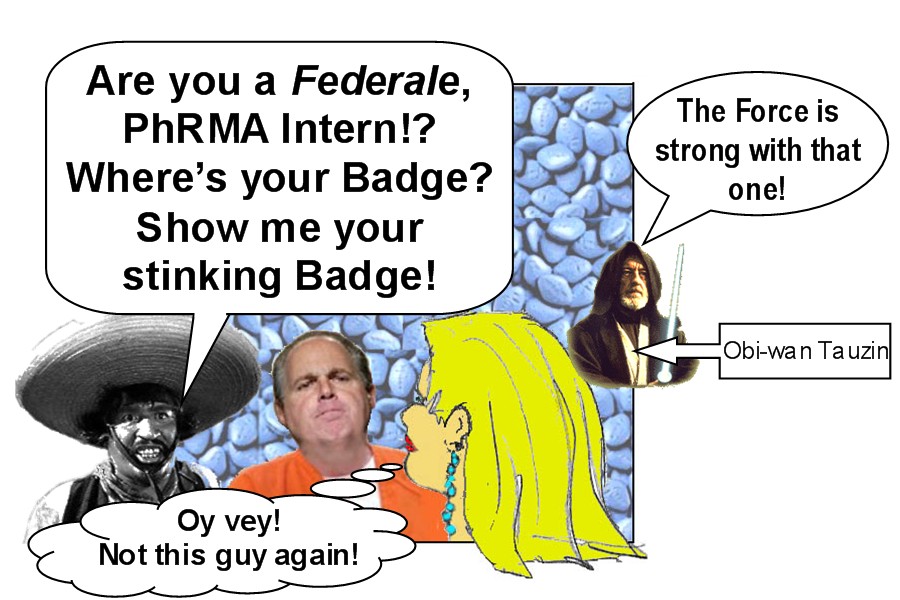
grabs Mr. Pudgy and immediately detains him and forces him to wear a prototypical terrorist orange jumpsuit. She is surprised, however, by counsel representing Mr. Pudgy...

Yikes! It's
Senor Counsel, PhRMA Intern!'s nemesis! Senor Counsel reminds PhRMA Intern! that when it comes to smuggling contraband Rx drugs into the US, not all citizens are equal.

Also, she realizes that her navigation system may be faulty. "This doesn't look like Canada to me," she says.


How to Keep Up with PhRMA Intern!
To keep up with the Further Adventures of PhRMA Intern, subscribe below.


Enter your Email Address


More Adventures of PhRMA Intern! are located HERE.


Do you want more or less of PhRMA Intern!
Yes, please continue!
No, I've had my fill of PhRMA Intern!
Yes, but bring more villians into it!
Whatever! You may be going too far!
Free polls from Pollhost.com

Friday, July 28, 2006

Generics: Physicians Less Informed than Consumers!


"Only your doctor can tell you if [Brand Drug Name Here] is right for you." is a phrase often seen in brand DTC (direct to consumer) print and TV ads. If generic drugs were advertised like their brand equivalents, the ads could
not say "Only your doctor can tell you if [Generic Drug Name Here] is right for you."

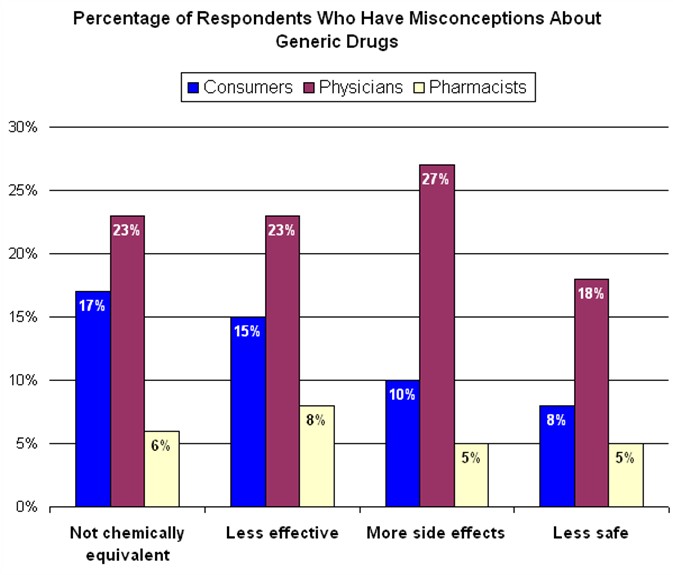
That's because, when it comes to misconceptions about generic drugs, physicians score higher than consumers.


According to the "
2006 Drug Trend Report" by Medco:

"The survey found that physicians trail consumers and pharmacists regarding their knowledge of and confidence in the safety and effectiveness of generic drugs which could have broad implications for the forthcoming boon in savings from the expected drug patent expirations of branded drugs worth over $40 billion in U.S. sales:
  • "One quarter of the physicians surveyed stated that they do not believe generic medications to be chemically identical to their branded counterparts; more than 8 percent said they were unsure. This despite FDA rules that require generic versions of the drug be bioequivalent to the brand medication
  • Nearly one in five physicians believes generic drugs are less safe than brand-name medications, and more than one in four doctors (27 percent) believe generic medications will cause more side effects than brands"
(See chart below.)

Pharmacists, on the other hand, know the score on generics.

It's shocking that physicians are less savvy about generics than their patients. But to understand why so many physicians harbor misconceptions about generics we need to look at the pharmacist data and ask: Why aren't the numbers for physicians closer to their professional pharmacist colleagues?


The one distinguishing factor is detailing by pharmaceutical sales reps. Only physicians are detailed on the "benefits" of brand name drugs vs. generics by sales reps. Pharmacists are merely urged to stock enough drugs to handle the expected surge of prescriptions resulting from a sales campaign.


When a brand drug faces generic competition, a major goal of the reps' "benefit" spiel to physicians is to cast doubt on the efficacy and safety of the generic equivalent. It appears that a substantial number of physicians swallow this spiel hook, line and sinker.
"With such overwhelming clinical evidence over a long period of time validating the therapeutic benefits of generic medicines, these survey results underscore the need to redouble our educational outreach efforts to physicians concerning generics," said Dr. Robert Epstein, Medco's Chief Medical Officer. "Generics deliver the dual benefit of quality therapy that provides economic benefits to the patient and payor, ensuring prescription healthcare remains affordable and accessible."
The drug industry spends $1 billion dollars per year on CME-accredited physician education, which can only mention drugs by their generic names. Despite that -- or should we say because of that -- doctors are still not educated when it comes to generics!

We shouldn't expect CME (continuing medical education) sponsored by pharma companies to help physicians understand generics. Most of this support comes from companies with new Rx brands entering the market when generics are not available. The physician is being educated to link the brand name with the great benefits and safety profile being presented simply because only the brand name drug is out there being promoted by PR (see "Marketing Disguised as PR").


Thursday, July 27, 2006

Rules of Engagement

I just made one small entry into Wikipedia -- the free online encyclopedia to which anybody with an Internet connection can contribute. It is just one small link on the page about Lunesta, which is here.

The article is very pharmacologically oriented -- almost like a package insert, except for one important difference. It includes information about Pharmacodynamics, Pharmacokinetics, Absorption, etc., but no "fair balance" -- that is, no information about side effects. A note posted in the discussion area linked to the article said: "I'd like to see some information about side effects, abuse, and effects in general."


To date, no one -- myself included -- has taken up the task of completing the article by adding the full prescribing information. There are links, however, to the full label as well as to the Lunesta and Sepracor Web sites.


My addition to the article was a link to the Pharma Marketing Blog post "
Lunesta: Golden or Bitter Pill?" I thought visitors to the Lunesta Wikipedia page might like to read that post.

I had another motive for adding this little bit to Wikipedia. It's a test of the concept of "engagement," which I reviewed briefly in my
Oped piece in the July, 2006 issue of Pharma Marketing News.

What exactly is "engagement"?


According to Dr. Joseph Plummer, chief research officer for the Advertising Research Foundation (ARF), an organization whose members include advertisers, advertising agencies, associations, research firms, and media companies,

"Engagement occurs as a result of a brand idea or media the consumer experiences which leaves a positive brand impression. It is now a critical advertising model to replace GRPs in the 21st century. It is important that we think hard about engagement to develop a robust measurement of when consumers are strongly engaged in brands, brand ideas and their surrounding environments." [See "The Advertising Research Foundation Announces Definition of Engagement".]
The working ARF definition is: "Engagement is turning on a prospect to a brand idea enhanced by the surrounding context."

What ARF is interested in is how to measure "engagement" so that advertisers who experiment with engaging consumers about a brand can measure how effective they have been. What I am interested in is the techniques that advertisers will be using or are using to do the engaging, not the measuring.


I haven't sorted all this out yet, but "context" and "environment" in the above definitions stand out. What these guys really are talking about is "intruding" in the lives of consumers no matter what they might be doing. Here's an example of what I mean that was recently reported in the
New York Times (see "New Rules of Engagement"):
What is this non-nuptial form of engagement? Dawn E. Hudson, president and chief executive of Pepsi-Cola North America, offered an example. In six weeks, Pepsi plans to begin an advertising and promotional campaign that will offer consumers customized ring tones for cellphones, which can be downloaded from the Internet with codes found under soft drink bottle caps.

"Whenever the phone rings, you'll think you got that from Pepsi," said Ms. Hudson, whose company is part of PepsiCo. That engagement with Pepsi products and that "depth of brand experience," she said, is far superior to what can be achieved with a "quick, passing message" like a TV commercial.
Another thing that consumers do and that advertisers would like to engage (intrude) in is creating their own content about brands on the Internet, especially in blogs, which is the most often cited form what's called "Consumer Generated Content" or CGC for short. I have written about CGC before -- see, for example, "Buzz 'n Blog Marketing" and "Buzz 'n Blogs -- Stealth Marketing."

Whatever the definition, pharmaceutical marketers are interested in "engaging" consumers (and physicians) through CGC channels. I know this because I have attended a few industry conferences where ideas for engaging consumers were discussed. Also, last week, BusinessWeek called me to ask about how pharmaceutical PR firms might be trying to influence bloggers like me. [I had to tell them that rather than "engage" me in productive conversation, most pharma PR people -- like the folks over at Sepracor -- refuse to answer my voicemail, letters, and e-mails.]


Engagement, therefore, is on pharmaceutical marketers' radar screens. But are they seriously engaged yet? That's where my Wikipedia experiment comes in.


Wikipedia is also a form of CGC, perhaps the most pure form of CGC. Anybody can write or edit a Wikipedia article. There have been over 50 contributions to the Wikipedia Lunesta article, for example. The original article could have been written by an ordinary Joe who may also be an employee of Sepracor. I can see what other Wikipedia articles this person wrote, but I don't think there is any bio that would tell me who he is or whether he is actually employed by Sepracor or not.


But, it doesn't matter who originally wrote the article. Anybody can edit what Joe wrote. Joe can go back and re-edit it, and so on and so on. It's like fingerpainting -- it's the process that counts (it's fun), not the finished piece of work.


Some Lunesta PR or marketing person may read this post, go the Wikipedia Lunesta page and edit out (remove) my brief link to "
Lunesta: Golden or Bitter Pill?".

And they will think "I have engaged the enemy and they are mine." But I will go right back and replace the link. Ha, ha!

Tuesday, July 25, 2006

Lunesta, a Sleeping Dog

Well, well, well. Sepracor, the pharmaceutical company that we love to hate for reneging on its pledge to comply with PhRMA's Guiding Principles for DTC advertising (see, for example, "Sepracor Sneaks In Lunesta Reminder Ad" and followup at "Adventures of PhRMA Intern!"), said sales of its sleeping pill Lunesta will be lower than expected.

Lunesta is a "dog," said David Southwell, Sepracor's chief financial officer, in an interview.


Actually, what he said was:

"We had thought we would spend a lot on direct-to-consumer advertising in the first half and back off in second half," he said. "Now we find we're the lead dog in the sled and to expand the market we need to expand our marketing and promotion budget in the second half of the year."
Sepracor blamed its lower than expected Lunesta sales on overall poor market performance in the category due to concerns over claims that certain drugs (ie, Ambien) can cause episodes of amnesia, sleep walking and binge eating.

Perhaps Sepracor's doggie ate its marketing and sales plan!


But have no fear. When all else fails, try "indication bloat" or what some call "disease mongering."

"Sepracor said it needs to differentiate Lunesta from other products if it is to sustain its rate of growth. The company is gathering an increasing amount of clinical data showing Lunesta to be effective in patients with co-existing conditions such as depression, anxiety, rheumatoid arthritis and menopause." (see Reuters story.)
Readers of this blog may recall that way back in September 2005, I predicted exactly this inevitable ploy (see "Insomnia--the Next DTC Frontier").
As the competition for market share heats up, you can expect to see these brands push the DTC advertising "envelope" the same way that erectile dysfunction (ED) drug ads did. What I am talking about is:

Indication Bloat
-- the tendency to inflate the estimated number of people that suffer from the drug's indicated condition. I have written on this topic before, using ED as a case study (see "Indication Bloat - The Next DTC Issue"). Like ED, insomnia may be difficult to define and most ads I've seen hardly mention insomnia at all. Instead, the ads use phrases like "Trouble Sleeping?" or "Tossing & Turning?" Here's some numbers you might hear:
An estimated 126 million adult Americans experience at least one insomnia symptom a few nights a week, according to the National Sleep Foundation, a group which receives some of its funding from drug companies. Only about a third of sufferers are actually diagnosed with insomnia, and a small fraction of those are treated with prescription medication. ("Ad war looms in crowded sleep aid market"; Boston Globe, July 19, 2005)
It sounds like we will see MORE, not less DTC ads for Lunesta in the future. These ads, however, won't be talking about "restless minds" worrying too much about work and such, but will take on a more serious medical tone similar to what we have seen with ED (erectile dysfunction) drug ads.

New Lunesta ads will say that insomnia could be a sign or symptom of a serious medical condition like depression and RA. The ads will focus more on women, especially peri-menopausal women in their 40s.


Sepracor may opt to take the unbranded DTC route similar to the GSK/Bayer "Mens Facts" ads that market Levitra to men with high blood pressure, high cholesterol, or diabetes (see "
Immutable Laws of DTC Domain Naming" and "Disease Awareness or Disease Mongering?").

One good result of all this may be that Sepracor will finally stop running "reminder ads," which cannot help "differentiate Lunesta from other products."


Interestingly, this move by Sepracor toward "disease awareness," unbranded Lunesta ads and away from reminder ads, if it happens, is motivated more by market forces (ie, competition, flagging sales) than by the desire of Sepracor to abide by PhRMA's Guiding DTC Principles. Expect Sepracor, however, to
announce that the change in the ads has more to do with the latter than with the former. I mean, that's what they should do if they were smart.

Keep Up with Posts About Lunesta!
THere will no doubt be further developments related to this topic that I will comment upon here. Keep up with this and other Pharma Marketing Blog topics by subscribing below.


Enter your Email Address


Monday, July 24, 2006

PhRMA Intern vs. the Pharma PR Agency!


Yes, it's
PhRMA Intern! Strange visitor from an Ivy League school who came to PhRMA with powers and ability far beyond those of Ken Johnson. PhRMA Intern! Who can change the course of mighty news stories, bend the truth at will, and who disguised as Emily Jameson (no relation to Jenna Jameson), mild-mannered intern for a great pharmaceutical trade association, fights a never ending battle for believability, justice for pharmaceutical companies, and the PhRMA way!


Our story begins in June, when John Mack, fearless muckraker writing in Pharma Marketing Blog, examined the role of public relations (PR) in pharmaceutical marketing (see "
Marketing Disguised as PR"). As an example, Mack cited stories in the press about Chantix, Alli, and Viagra.

Mack contacted
Emily Jameson -- the mild-mannered intern at PhRMA (America's pharmaceutical trade association) -- and told her about these stories.

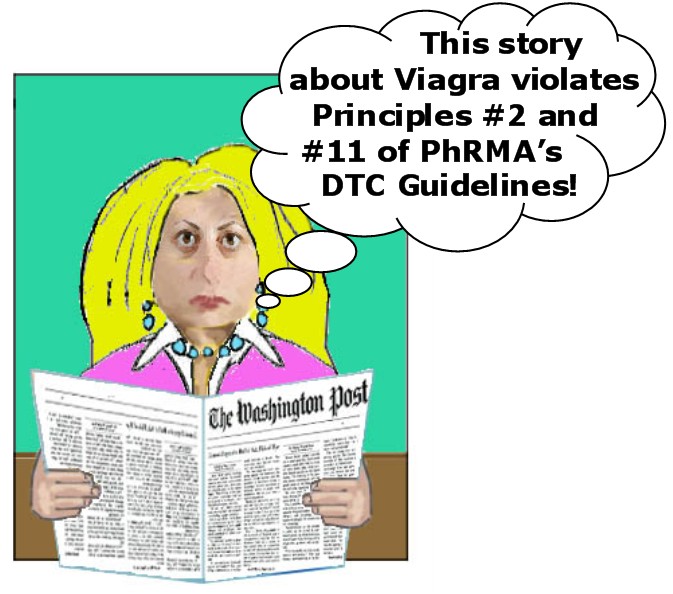
We open with Emily reading a story about Viagra in her local paper, which happens to be the Washington Post...


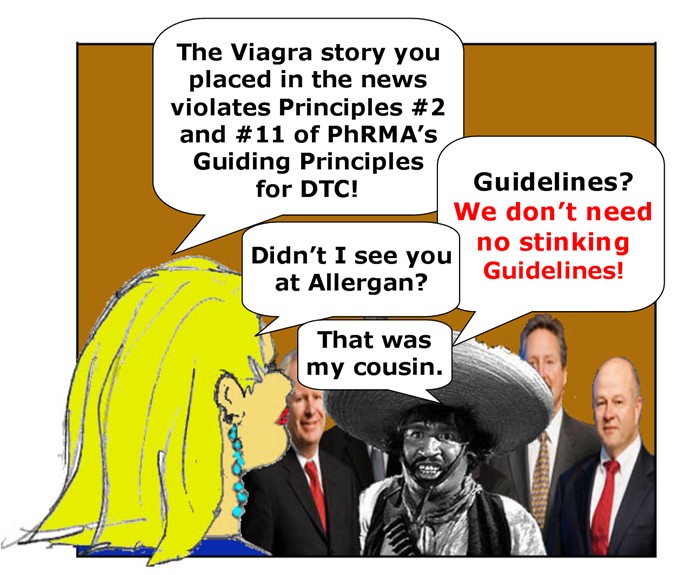
Almost immediately, Emily noticed that the story did not comply with FDA regulations. Specifically, the story did not balance risks and benefits and mentioned the use of Viagra (and Cialis and Levitra) for daily treatment for the prevention of erectile dysfuntion in men with cardiac problems, which is not consistent with FDA approved labeling (see "Blockbuster vs. Ballbuster?").

Thinking that no news article about a drug is written without assistance from PR professionals employed by the pharmaceutical industry, Emily felt that these stories should comply with
PhRMA's Guiding Principles for DTC Advertising, especially Principles #2 and #11.

As always, Emily acted quickly, ducking into PhRMA's
renowned Office of Accountability ...

where she changes into
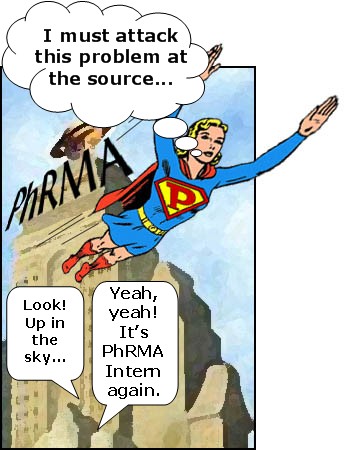
PhRMA Intern! by now a familiar sight over the heads of pedestrians outside PhRMA headquarters in Washington, DC. [It should be noted that the Department of Homeland Security honored PhRMA Intern! with a special waiver of the DC "no fly zone" rule.]


A few minutes later,
PhRMA Intern! lands at the Chandler Chicco Agency offices in New York City and confronts the Pfizer team there only to be foiled again by a familiar character. Is this PhRMA Intern's Lex Luther?
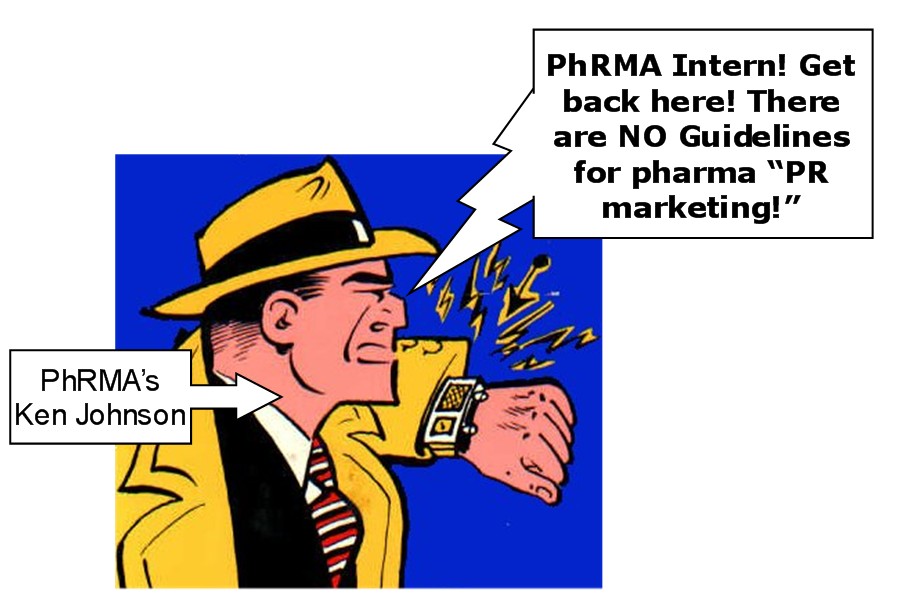
Ken Johnson, VP at PhRMA and Emily's boss, contacts
PhRMA Intern! using his 3-way wrist radio...
Frustrated in her attempts to reign in unregulated pharma PR practices, Emily returns to her desk at PhRMA and tries a different tactic...


Take The Pharma PR vs. Advertising Survey!

Karl von Clausewitz (1780-–1831), Prussian general and military strategist, has been purported to have said that war "is merely the continuation of policy by other means." If you look at marketing drugs as a kind of war, then you might say that public relations (PR) is marketing by other means. That is, by means other than advertising, which most people equate with marketing.


Longtime marketing strategist Al Ries and his daughter/business partner Laura Ries (A&L) espouse this definition of marketing:


Marketing = PR + Advertising (specifically, PR first, advertising second)


"PR first, advertising second. This is the key to success in today'’s marketing arena" is the main takeaway message of the book,
The Fall of Advertising and the Rise of PR, written by A&L.

A&L compare PR with advertising and make these claims, among others:

  • PR is credible, advertising is not
  • PR builds brands, advertising defends brands (cheerleads)
  • PR is creative, advertising is uncreative
Do you agree with these claims? Does the rule "PR first, advertising second" apply to pharmaceutical marketing? Should the pharmaceutical industry develop PR guidelines to parallel the guidelines it developed for DTC advertising?

Please help
PhRMA Intern! by answering these questions--take the Pharma PR vs. Advertising Online Survey now! After completing the survey you will be able to see a summary of results (de-identified, excludes open-ended responses and comments that may identify the respondent). You can also use filters to examine results from different subsets of respondents (e.g., pharma company employees vs. non-pharma people, etc.)

How to Keep Up with PhRMA Intern!
To keep up with the Further Adventures of PhRMA Intern, subscribe below.


Enter your Email Address


Do you want more or less of PhRMA Intern!
Yes, please continue!
No, I've had my fill of PhRMA Intern!
Yes, but bring more villians into it!
Whatever! You may be going too far!
  
Free polls from Pollhost.com

Friday, July 21, 2006

Fear & Loathing in Bethesda

The Union of Concerned Scientists (UCS) recently released survey results from 997 FDA scientists that demonstrate pervasive and dangerous political influence of science at the agency. Thirty-four percent (34%) of respondents were consumer safety officers and 62% were top-level officials.

According to the
UCS press release:

"Forty percent of respondents fear retaliation for voicing safety concerns in public...More than a third of the respondents did not feel they could express safety concerns even inside the agency. Nearly one-fifth (18.4 percent) said that they 'have been asked, for non-scientific reasons, to inappropriately exclude or alter technical information or their conclusions in a FDA scientific document.'"
One FDA scientist that is not afraid to speak out is Dr. David Graham, part of the Food and Drug Administration's drug safety office, who, according to an article in the New York Times ("Approval of Antibiotic Worried Safety Officials"), "wrote in a message dated June 16 that the agency's approval of Ketek, an antibiotic made by Sanofi-Aventis that is also known as telithromycin, was a mistake."

I covered the Ketek safety issue in a previous post to this blog (see "
Celsius 3014: Ketek, Drug Safety, & Bioterrorism") in which I suggested that the FDA's approval was pressured by the political demands of the Department of Homeland Security. What I thought was a conspiracy theory may yet turn out to be more fact than conjecture!

This all has to do with "post-market surveillance" and NOT with the balance of benefit vs risk as some pundits have claimed. It's difficult to make a risk-benefit calculation if you don't have reliable data and that is what is at the heart of the Ketek case. According to Graham:

"We don't really know if the drug works; no one is claiming it works better than other, safer drugs; and weÂ’re flying blind as far as safety goes, except for our own A.D.R. data that suggests telithromycin is uniquely more toxic than most other drugs."
[It should be noted that some critics of Dr. Graham attack his character rather than his opinions. One example: "David Graham who is to rational evaluation of the risks and benefits of medicine what Hezbollah is to advancement of peace in the Middle East..."

Q: How do you distinguish a conservative from a liberal these days?

A: The conservative, eg, Karl Rove, criticizes the character of an opponent, the liberal criticizes the opponent's point of view.]
ADR data is notoriously unreliable, but the safety data from post-marketing surveillance studies done in France and Latin America (ie, "Study 3014")--upon which basis Ketek was approved--may be even more unreliable.

"For F.D.A. to refer to its being reassured by postmarketing data from Latin America and Europe as a basis for declaring 'Ketek is safe' is in my opinion a great abuse of such surveillance data," Dr. Graham wrote.


Political influence over science is one thing, but mixing politics and bad science is a formula for disaster. Maybe Ketek is not the most dangerous drug on the market, but it could be the canary in the minefield that is the state of postmarketing surveillance in this country (for more on this topic, see "
Spinning Bad News about FDA & Drug Safety" and "FDA Paralyzed: Who Will Protect Us?"

For additional blog posts about the FDA, see:


How to Keep Up
To keep in the loop with posts made to Pharma Marketing Blog, you could
subscribe to the newsletter and/or online forum or you can receive notice by email whenever a post is made to Pharma Marketing Blog by subscribing below.


Enter your Email Address


Thursday, July 20, 2006

A Milestone Is Reached!

This week marks a milestone for Pharma Marketing Blog: The 200th post since this blog was started in January 2005 was made on Tuesday (see "Rozerem Ads Dis Lincoln, Show Beaver") ! That's approximately 1 post every 3 days. I figure I spend about 20% of my working hours writing this stuff!

Is it worth it? Hell, yes!


Synergies

Pharma Marketing Blog fits in nicely with the other stuff I do to earn a living -- especially publishing
Pharma Marketing News (click here and you can download the latest issue, FREE!), the Pharma Marketing Network Web site, and the PHARMA-MKTING Online Discussion Forum.

Pharma Marketing News is focused more on the views and opinions of other experts who are not afraid to discuss the issues. The mission of the newsletter, like the Web site, is to provide information that helps pharmaceutical marketers find the resources they need (see, for example, the
Pharma Marketing Vendor Directory).

How do I gain access to these experts? First, I offer them an online community where they can interact with other experts in confidence (see
PHARMA-MKTING). It's a good forum for people newly breaking into the industry as well, as this comment from a member attests:

"I just wanted to take a moment to thank all of you who were kind enough to take time out of your day to help a 'newby' such as myself. I was truly touched by the number of responses I received. I hope it brings you a certain sense of happiness to know that you offered a 'stranger' some help, and made a difference in my life!" - Teresa
PHARMA-MKTING a perfect venue for networking, in which I strongly believe. I also believe in helping others, which often pays back by them helping me.

Pharma Marketing Roundtable

I also provide another forum, called the
Pharma Marketing Roundtable, for a select few experts. The Pharma Marketing Network Roundtable is a series of periodic teleconference/webinar meetings of pharmaceutical marketing experts for the discussion and exchange of views on topics of interest to pharmaceutical marketing and sales professionals. I often summarize Roundtable discussions in the newsletter. Here are a few recent examples:
The Helpful Critic!
Believe it or not, I am not your run-of-the-mill critic of the pharmaceutical industry. The "Insider" over at
PharmaGossip had this to say about me:
He is relatively industry friendly, but doesn't hesitate to also beat up on any company, product, or practice he doesn't like. He also brings an interesting personal perspective to some of the things that are going on in la la land, I mean the pharma world.
Note: The Insider often contributes comments to this blog, so be sure to check out the comments section whenever you're here.

Couple of things:

  1. I never met a company or product I don't like (I really believe that most drugs are useful; sometimes I only question if they are as useful as drug companies claim they are).
  2. Nor have I ever met a pharmaceutical marketing executive or product manager who I didn't like. It's some of the things they do that I don't like. I'm talking about marketing practices. Something happens when nice people get together in a big company and are charged with "making the numbers." Sometimes, they lose sight of what's right. That's when I try to set them right.
Hire Me!
I actually also consult for the pharmaceutical industry. See my consulting company Web site: VirSci Corporation. I guess you can call this a disclosure. My consulting work is focused on the same areas that this Blog is focused on: Best Practices and eMarketing Intelligence.

In my consulting, I try to point out speed bumps along the road to my pharma clients. For example, I was recently hired by a major pharmaceutical company brand team to provide them with a 50,000-foot view of the marketing mix and regulatory atmosphere in the next 1 to 5 years. I can do that because I stand on the shoulders of giants, such as the members of the Pharma Marketing Roundtable, who provide me with their insight. In return, I refer these experts to my clients.


Must Read Blog!

PharmaGossip Insider also
awarded
Pharma Marketing Blog second place among all healthcare blogs! Thank you for that. The Wall Street Journal, back in November 2005, called Pharma Marketing Blog a "must read for people who want to stay current" (see "WSJ Cites PM Blog as 'Must Read'").

How to Keep Up

To keep in the loop with posts made to Pharma Marketing Blog, you could
subscribe to the newsletter and/or online forum or you can receive notice by email whenever a post is made to Pharma Marketing Blog by subscribing below.


Enter your Email Address


Wednesday, July 19, 2006

DTC Menagerie & Bad Buzz

Yesterday, I posted a commentary about the imagery of the new DTC ads for Rozerem, a sleep aid drug from Takeda Pharmaceuticals (see "Rozerem Ads Dis Lincoln, Show Beaver"). I was mostly confused by the meaning of the imagery, especially the beaver. Several people submitted comments about that post here and over at the Pharma Marketing Online Discussion Board. Before getting to these comments, I thought it would be interesting to examine other creatures, real and imaginary, that inhabit the world of pharmaceutical DTC advertising (see figure below).

You are probably familiar with these denizens of the DTC netherworld. The Rozerem beaver and the Lunesta moth are the latest inhabitants to come on the scene. These creatures have become icons for their respective products.

To be sure, other consumer products use animals in their ads -- Coca Cola uses polar bears, Energizer uses a bunny, Budweiser used to use lizards, etc. Here's what "world-renowned marketing strategists" Laura and Al Ries have to say about "The Zoo on Madison Avenue":

"Are animals in advertising good or bad? Like every question in marketing, the correct answer is always the same: it all depends.

"It all depends on what you are promoting. If you are promoting a zoo, animals are probably a good idea. If you are promoting an automobile, probably not." -- from
The Fall of Advertising & The Rise of PR.
These experts claim that the use of animals in ads is the result of "creative thinking" at ad agencies. To be really creative, the ad agency must come up with an animal no one else is using. Hence, the beaver in the Rozerem ads.

Brian Towell across the pond at doghouseonline.com rationalized the choice of beaver thusly:

"While a beaver may be a questionable choice, there is probably no harder working or more industrious animal (apart from bees and ants which are far more threatening/nightmarish) on the planet. So we have the combined virtues/analogies of honesty and industry working together to give us a good night's sleep."
Which just goes to prove the Ries' point: the bee was taken (Nasonex) -- and so was the ant (ReQuip) -- so the logical next choice was the beaver!

But, as I suggested in my post yesterday, the beaver also conveys another message. As one anonymous commenter said:

I don't like the talking beaver either, but its use seems obvious to me (as a male) -- the guy dreams about "beaver," aka sex. It's exactly the politically incorrect interpretation John alludes to. And yeah, it's pretty hokey when you think about it. Too clever by half. What's next, a train?
Mascot Giveaways
I think, however, that we read too much into it when we try to psychoanalyze the reasons why certain animals or creatures are chosen for drug ads. The more important purpose is to create a mascot that be a surrogate for the product, especially as gifts to physicians. I imagine little beaver statuettes on the desks of physicians. The beaver puts a smile on the doctor's face (especially male doctors) and reminds him of the product and the rep who gave him the gift. Of course, it's not going to influence what he prescribes, but it got the rep through the door and the doctor might agree to see him again.


Take a look at "Digger the Dermatophyte."

Digger looks nothing like an actual dermatophyte. But it is kind of "cute" and a character that can easily be converted into a promotional item as a giveaway for physicians. BTW, how many consumers actually believe dermatophytes resemble "Digger?" I am betting quite a few.


Other Comments About Rozerem Ad Campaign

Several people over at the Pharma Marketing Online Forum felt that the Rozerem advertising was effective (especially the Web site).

Alfred O'Neill said:

Your comments about lack of space devoted to safety information is well-put. Lunesta looks like a great drug until you read the fine print about comas.

But the fact is, this web site [Rozerem.com] works on a few levels brilliantly. The content is excellent. The personalities engaging. The overviews thorough. It's pharma speaking to me in an engaging and approachable way -- wow, they recognize me as a human!

What is most interesting is the integration of video into the text -- I think a first for a pharma brand. This is radical for pharma because it makes their communication go beyond the myopic "pill-to-person" model which is so flat and artificial and in many instances alienating.

This humanizes the information and differentiates the brand from other sleep aid sites. It taps into how people are starting to consumer other information -- the CPG marketers get this already and are moving all their communications to be more interactive and engaging. But pharma is barely past brochure-ware educational experiences.

This campaign may have its issues, but the Web site is outstanding. Congrats to the agency and client!
Brian Towell said:
I think this is OK. It connects with me in a number of levels, some of them very obvious, others quite subtle.

While a beaver may be a questionable choice, there is probably no harder working or more industrious animal (apart from bees and ants which are far more threatening/nightmarish) on the planet. So we have the combined virtues/analogies of honesty and industry working together to give us a good night's sleep.

On a more disturbing level, while the copy promises little in the way of dependence/addiction, the imagery makes an unnerving inference of weird/hallucinogenic (but non-threatening) dream states.

That will probably be good for sales, so I congratulate the Agency and the brand team at Takeda for a job that is, on the face of it, well done.

A recent discussion with sleep disorder experts has postulated that dreams (apart from the unconscious valeting role) also function as guardians of sleep, so the relevance of the simple creative idea is also profoundly 'real' to people who lose sleep.

For once, a healthcare campaign that deserves to be applauded.
Blog commenters were a little less appreciative. Here are a couple:
OK. I just visited the website - haven't seen the print or TV versions. The beaver is freaking me out. I might just have nightmares tonight thinking about it. I agree - they should have thought about this a little more before launching this campaign. Then again, maybe in a crowded sleep market they are looking for something different to create buzz. However, as you pointed out, the market that will think this is cool/funny/hip is probably not in need of insomnia medication. I am!
And...
The photo seems to me to be some ad person's notion of what constitutes a Freudian dream, which tells me how hokey is the thinking of some ad people.
John Mitchel at buzzback.com said:
Re the clock [on the Web site, displaying the real time vs. perpetually set at 3 or 4 AM]. But if you are among the target, maybe their thinking is the clock will show you 2 AM, 4 AM... whatever it is when you are awake surfing the web, not sleeping. I am not saying that's right, just trying to figure what the logic is. Ambien runs a lot of ads in the middle of the night. Hits the target. Maybe rozerem will or is running online or tv ads in the night with a call to action to go to the website. could be pretty productive. Or a programmer did the clock on her own initiative and no one in marketing management noticed it, or they did notice and got overwhelmed with "how freaking cool our website is..." It's a pitifully easy tool to implement
Bad Buzz
At least one commenter noted all the buzz the Rozerem ad imagery has created and therefore suggested that it has achieved its purpose. Al and Laura Ries would say that only PR can create buzz, not advertising. I would say that yes, it has created some buzz here and among advertising professionals (the Rozerem ad agency is probably patting itself on the back right now), but where's the buzz among consumers? Maybe the Wall Street Journal or New York Times will pick up on this discussion and write a story. It could be a negative story, however. That is, it could be "bad buzz."


In my opinion, the Rozerem ads are likely to generate more "bad buzz" than good buzz. I don't think the industry needs any more "bad buzz" about DTC advertising. Unless you think that ALL buzz -- good or bad -- is productive, then drug advertisers should spend less time trying to be creative and more time being communicative -- ie, better communicate what's special about Rozerem. IMHO.

Tuesday, July 18, 2006

Rozerem Ads Dis Lincoln, Show Beaver

I'm trying to figure out the thinking behind the new DTC (direct to consumer) ad campaign for Rozerem, the new sleep aid pill brought to market by Takeda. The ads feature Abraham Lincoln and a beaver. I find the ads disturbing, although they do stand out from the crowd of sleep aid ads -- a space growing more crowded every day.

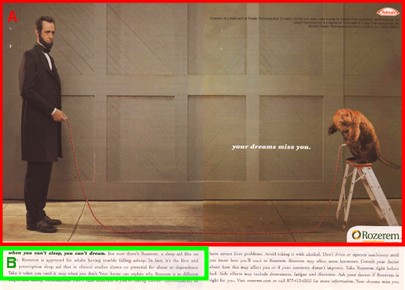
I first saw the Lincoln/beaver ad in print format (see figure below).


This 2-page spread appeared in a recent issue of Prevention magazine. I don't get the dream imagery, unless Abe and beav are inviting me to jump rope! Leaving the purpose of the image aside for now, the ad is unique in the amount of space devoted exclusively to the image (labeled "A" in the figure). An astounding 81% of the ad space (not including the 2-page package insert portion of the ad, which is not shown here) is devoted to the graphic! This is the highest image percentage of any Rx print ad among the 50 or so that I have looked at -- Lunesta came in second at 79% (is it a coincidence that both these ads are for sleep aids?). The average is about 46%, which is still a considerable area to devote to images. But that is what advertising is all about - imagery. Information -- such as benefit and risk information -- is secondary. In the Rozerem print ad, only a miniscule 4% is devoted to benefit information (labeled "B" in the figure) and 6% is devoted to fair balance (ie, the risks).

[Lunesta ads are not much better. In the Prevention ad for Lunesta, 12% of the ad space is devoted to benefits and 5% to risks. The average for the 53 ads that I studied is 20% and 12%, respectively].
The paucity of space devoted to risk information in these ads is amazing considering that advertising agencies are petitioning the FDA to further limit the space devoted to risk information in DTC ads of all types (for more on this, see " DTC Without the Risk" and "Communicating Risk: Let the Dialog Begin"). These "communication experts" argue that too much risk information will "confuse" people or scare them away from beneficial treatment options. Of course, Abe Lincoln playing jump rope with a beaver couldn't possibly confuse or scare anyone!


Advertisement
Direct-to-Consumer Advertising
Volume One: Emerging
Issues


DTC Vol 1 Supplement CoverThe collection of articles and commentary in this first Pharma Marketing News Special Supplement dedicated to DTC advertising chronicles the emergence of issues and debates that have lead up to the industry's self-regulatory principles.

Order Vol 1 Here. PDF file delivered by email.


Why Lincoln?

Lincoln is an icon for "telling the truth" and a study by the University of Chicago Medical Center reveals that Lincoln may have suffered from bouts of depression, anxiety and insomnia. He was taking a medication common at that time for depression, known as "Blue Mass." Good enough, I suppose for a drug image icon -- beats a lunar moth!


Why Beaver?

But why the beaver? I haven't got a clue. All I know, back in the day when I designed pharmaceutical sales training programs, political correctness forbade the use of "beavers" in any graphic.
I designed a board game, for example, in which a beaver navigated through obstacles like rivers, etc. to reach a goal. Sales reps helped the beaver by answering questions correctly. Cool idea, especially considering the use of interactive animation. However, the beaver was politically incorrect -- as was the overweight Samoan -- and we had to lose the tail and make it into some kind of gopher-like animal. I'll never forget that.

One thing I have to say, Takeda's ad agency is consistent in integrating print, TV, and Web advertising -- at least as far as the imagery is concerned. The Lincoln/beaver thing is integral to the TV ad -- I saw the tail end of one for the first time last night -- and the Web site as well as the print ads. Here's what the home page of the Rozerem Web site looks like:


This Web site takes interactive animation/video to a new level. It evens features downloadable TV ads and podcasts -- both of which I couldn't use (Windows could not figure out what application to run to view/hear these and the site doesn't offer any help; I doubt many consumers will bother with them).


Advertisement
Direct-to-Consumer Advertising
Volume Two: Best
Practices


DTC Vol 2 Supplement Cover
Volume Two this Special Supplement is devoted to DTC Best Practices with a focus on techniques for improving DTC campaigns. Included are interviews with many experts on branding, market research, alternative media, and direct marketing.

Order Vol 2 Here. PDF file delivered by email.


The man, Lincoln, and the beaver all entice you to click on them and other parts of the image -- like the tea kettle -- to get more information. Cute. But after awhile it gets boring and repetitive.

BTW. I missed this at first, but take a close look at this detail of the Web site homepage image. Notice anything peculiar aside from Lincoln and the beaver?

The clock says it's twenty minutes to eight! The guy is supposed to be suffering from insomnia -- it should be 3 or 4 am in the morning! So, what's with the clock?

It's real time! How do they do that? Why would they do that?
In one scene, pictured above, the guy asks you to click on the message board to get a coupon for a prescription rebate. Lincoln responds with a rapper shtick -- crosses arms, says "Oh Yeah! It's all about the Linkage!" Get it? Linkage/Lincoln? My son can probably relate to this, but not me. Unfortunately, not too many teenagers I know suffer from insomnia (what's the opposite of insomnia?). So why is Lincoln rappin'? This may be even more politically incorrect than the beaver!

Takeda, respectful of PhRMA's Guiding Principles for DTC advertising, waited a full year after the FDA approved Rozerem to launch its DTC ad campaign. Perhaps it should have taken a little more time to think it through.

Monday, July 17, 2006

PhRMA Intern vs. BOTOX!


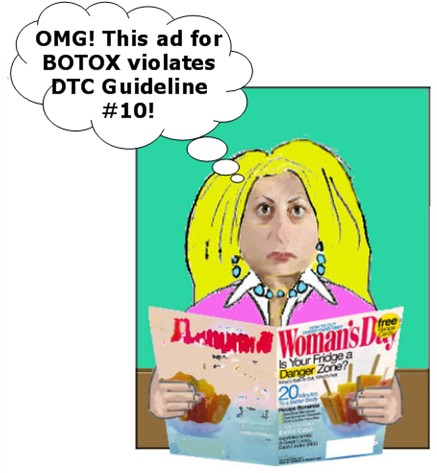
On her lunch break, while innocently reading the latest issue of Woman's Day magazine, Emily Jameson, mild-mannered summer intern at PhRMA -- America's pharmaceutical trade association -- is startled by an ad she sees...


Emily believes that Principle #10 of PhRMA's Guiding Principles for Direct To Consumer Advertising for Prescription Medicines calls for the elimination of so-called "Reminder Ads," which are usually 30-second TV commercials that mention a drug's name without stating the health conditions for which the medicine is approved and without listing the major risks associated with the drug. These ads are perfectly legal from a regulatory point of view.

You might have seen reminder ads on TV for Lunesta (see, for example, "Sepracor Sneaks In Lunesta Reminder Ad").
Here's the BOTOX ad Emily saw in Woman's Day magazine:


According to the BOTOX Web site, BOTOX Cosmetic is indicated for the "temporary improvement in the appearance of moderate to severe glabellar lines [ie, wrinkles between the brows] associated with corrugator and/or procerus muscle activity in adult patients." Neither lady in the ad exhibits any hint of glabellar lines, which I suppose is the point -- they've already been "hit up" with their BOTOX injections and are enjoying their brief "time" between injections!


But you already know what BOTOX is for!
Very few people have escaped the PR and buzz about BOTOX, which has become part of the culture of many countries (in some countries, however, people are much less concerned about wrinkles between the brows). Again, this is the power of public relations as a marketing tool (see, "Marketing Disguised as PR", for more on this).
Viagra is another drug that has benefited greatly by PR and buzz. However, you won't see any Viagra reminder ads -- at least not in the US. Here are some examples of what are purported to be Viagra reminder ads in other countries.
Once again (see the first installment of "The Adventures of PhRMA Intern"), Emily is quick to respond:

Ducking into PhRMA's Office of Responsibility, mild-mannered Emily Jameson -- lowly summer intern -- transforms into PhRMA Intern!


BOTOX is produced and marketed by Allergan, a biotechnology company that likes to call itself a pharmaceutical company. BOTOX Cosmetic accounts for perhaps 40% of Allergan's total sales.

Just a few minutes after leaping from the small window in the Office of Accountability,
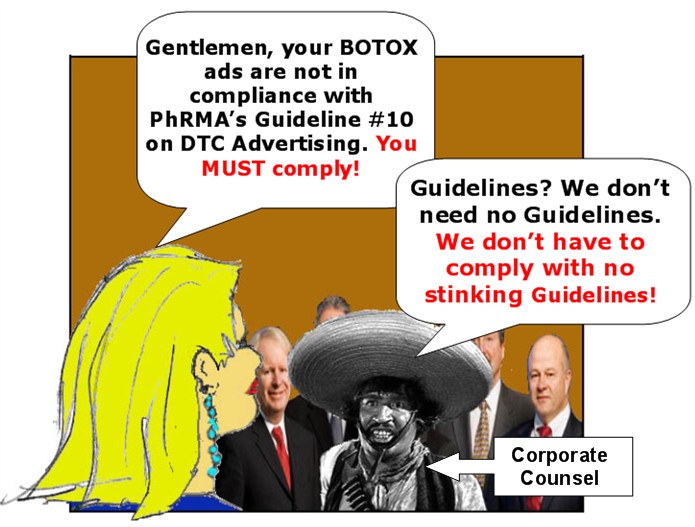
PhRMA Intern lands at Allergan headquarters in Irvine, California and confronts Allergan's Executive Committee (and Corporate Counsel)...


PhRMA Intern offers the BOTOX print ad that she ripped out of Woman's Day magazine as proof of non-compliance. She doesn't mention all the similar BOTOX TV ads she has seen. Since PhRMA Intern didn't mention the TV ads, and because PhRMA's DTC Guideline #10 only applies to TV ads and NOT to print or Internet ads, Allergan's Corporate Counsel can truthfully claim that Allergan needs "no stinking guidelines."

"Drats," exclaims PhRMA Intern, "foiled again by a wily corporate counsel!"


Back at PhRMA headquarters,
PhRMA Intern -- now disguised as mild-mannered Emily Jameson -- learns the REAL reason why Allergan can run BOTOX reminder ads with impunity!

Not only are PhRMA's Guiding Principles voluntary, they apply only to PhRMA's member companies and only to those who have agreed to comply with them. [If you are trying to search PhRMA's Web site for the signatories, don't bother. There is no such list available.]

Allergan, like other biotech and specialty pharmaceutical companies, is a member of another trade association headed up by a former politico:
BIO, the Biotechnology Industry Organization.

Considering that biotechnology companies like Allergan are beginning to market their products directly to consumers much like the rest of the pharmaceutical industry (see "
Biotech DTC: Business Not As Usual"), it behooves BIO and its member companies to at least do what PhRMA has done: draw up a set of principles for DTC advertising that its members can use.

PhRMA Intern says: "Considering that many biotech drugs (eg, injectables) have very serious side effects -- BOTOX Cosmetic's side effects include 'serious heart problems and serious allergic reactions' -- BIO should certainly insist that its members NOT run reminder ads on TV, in print, or on the Internet!"


Do you want more or less of PhRMA Intern!
Yes, please continue!
No, I've had my fill of PhRMA Intern!
Yes, but bring more villians into it!
Whatever! You may be going too far!
  
Free polls from Pollhost.com

Thursday, July 13, 2006

Question Everything


As reported in yesterday's Wall Street Journal, "Awaiting approval from U.S. regulators to sell an over-the-counter diet pill called Alli, GlaxoSmithKline PLC has set out to establish itself as an online weight-loss authority, with a Web site that offers dieting tips and collects data and email addresses from consumers who visit" (see "Web Site Is a Prelude To Glaxo's OTC Weight-Loss Pill").

The Web site is Questioneverything.com.

Although this Web site is not new -- it was first launched in April -- it was new to me, illustrating again the value of good PR as a marketing tactic (for more on PR and marketing, see "Marketing Disguised as PR" and "PR Marketing: Mystery Wrapped in a Riddle").

In synch with the spirit of questioneverything.com, I question a few things about the site and its purpose.


I Question if Barriers to Alli Can Be Overcome

For those of you who do not know, Alli is a low dose form of Xenical, a prescription diet pill that has been on the market for a long time. It hasn't done very well, however. It received a lot of bad press around the time it was launched because of its unpleasant side effects -- especially "anal leakage." Need I say more? Yes, I do!

Obviously, GSK needs to overcome some barriers associated with Xenical's side effects. A name change is only the first -- albeit very important -- step. With apologies to Shakespeare:

What's in a name?
That which we call Xenical by any other name
Would cause anal leakage as foul.
How to prevent this side effect or at least deal with it when positioning Alli after approval is the second barrier to overcome.

The flatulence and anal leakage side effects can be mitigated by sticking to a low fat diet, which is advocated on the site. As the WSJ article notes: "Clinical trials indicate that people taking Alli experience fewer gastrointestinal side effects if they stick to a low-fat diet. Alli blocks the body's absorption of dietary fat, which results in flatulence and other unpleasant side effects. If it is cleared for sale, Alli would be the first FDA-approved OTC diet pill on the U.S. market."

The third barrier is competition from other OTC products, including supplements like Hoodia, which I am sure you've been getting a lot spam emails about. The name of the site -- Questioneverything -- helps implant the message to deal with this barrier: question everything about the competition. There's an entire section devoted to bashing supplements entitled "Weight loss supplements: Do they work or not?" There's even information about how to file a complaint about supplements to the FDA! I am sure, you won't see similar instructions for filing a complaint about Alli on its site once that product is approved!
BTW, questioneverything.com is another example of what I have called the "Immutable Laws of DTC Domain Naming."
I Question Who the Site Aimed At
One thing that bothers me about the site is its feminine appeal and lack of any attention to males. According to US government statistics of adults over 20 years of age, more US males than females are overweight (68.8% vs. 61.7%, respectively). If anything, therefore, the site should be aimed at males. I guess they believe either that men are a lost cause for diet pill marketing or that women are making decisions for men. But as a man who is grappling with a weight issue, I know that there are certain male issues related to weight loss that really motivate me.

Every graphical image of a human figure on the site, however, is female. Cute ones to boot! (See home page image below.)


I Question the Site's Online Discussion Board
Another feature of Questioneverything.com that you will not see on the Alli web site once it is operational, is the moderated online discussion board. Virtually every page of the site encourages you to join the discussion. It's obviously the most important part of the site as far as marketers are concerned.

The board is pre-loaded with topic areas such as "Your heart should race from being in love, not from your diet pill" and "You're working hard. So how come it's not enough?" As pointed out in the WSJ article, the discussion board is a clever way to gather consumer attitudes about dieting issues that can be used to position Alli. Reading posts to the board and responses from other "visitors" and the paid moderators gives us a glimpse into how these discussions are not just mined for information, but also manipulated to constantly repeat the positioning messages already in place.

To test this, I posted my own message and tried to stay within the rules. At first, I didn't know where to post my comment -- no topic was really appropriate and the site does not allow you to create a new topic area. I chose the first topic area -- "Your heart should race from being in love, not from your diet pill" -- because it was top of the list and I could create a catchy title. NOTE: This topic area is obviously designed to capitalize on the cardiovascular problems of some diet pills that will compete with Alli.

Here's my post and the replies:
July 12, 2006, 8:12 AM 2599
johnmack
* You -- not your heart -- should race from obesity meds
I am concerned about all the hype swirling around new drugs to treat obesity like Acomplia (approved in the EU and soon in the US; see http://pharmamkting.blogspot.com/2006/06/fat-acomplia.html) and Alli (an OTC version of Xenical, soon to be marketed by GSK, owner of this site). Diet and exercise alone can deliver better results in a shorter amount of time than with some of these drugs -- I know: I lost 13% of my body weight in only 6 months by starting out with the South Beach diet and then just cutting out carbs, watching portions, and cutting back on beef and other meat. In trials of Acomplia, on the other hand, those taking the drug shed only between 5% and 10% of their body weight if they stayed on the drug for two years! Some deal! Also, Acomplia and other obesity drugs are approved only as an adjunct to to diet and exercise. So why take these drugs at all if they cannot accomplish the same weight loss in as short a time as diet and exercise? Besides, there are side effects from all drugs and not just involving your heart. Xenical, for example, can cause flatulence and anal leakage (referred to euphemistically in today's Wall Street Journal article about this Web site as "incontinence"). I'm wondering what other people on this forum think. (Too bad we can't create our own topic areas!)

Reply
July 12, 2006, 4:35 PM 2604 in reply to 2599
bfenn
* Re: You -- not your heart -- should race from obesity meds
I, like you, am very concerned with obesity medications that potentially cause more problems than they solve. Four years ago, I had a stroke. I was just 35 years old and "on paper," I was pretty healthy - normal cholesterol, normal blood pressure. But, I was significantly overweight - 298 lbs. Just like my father and sister, who both opted for the gastric bypass surgery. Fast forward three years and I still hadn't taken control of my life. I finally decided to go to a bariatric specialist to find out how to slay the fat demon once and for all. Well, as you can imagine, the doctor was leery about any medication that would affect the brain - due to my stroke. So, he talked to me about Xenical. First, he asked if I was serious about losing weight. I responded "Absolutely!" Then he told me how Xenical works - blocking 30% of your fat intake. However, there was a major caveat - "fat eater beware!" He also explained the side effects and, yes, flatulence and anal leakage got my attention. I was so worried about the side effects that initially I don't think ate over 20 grams of fat all day! Next week will be exactly one year and I have lost a total of 110 pounds with the help of Xenical (and my wonderful doctor, of course). I cannot express in words the difference it has made in my life. I do believe it is possible to lose weight with pure diet and exercise but for most, it's easier said than done. I still watch my fat intake religiously and have never had one side effect from the drug. To me, Xenical is one rung in the ladder of weight loss success. But, to me, it made the climb to the top so much easier.

Reply
July 12, 2006, 11:19 PM 2612 in reply to 2599
BettyRD
Moderator
* Re: You -- not your heart -- should race from obesity meds
Hi Johnmack, I have to admit that before I began working in the field of weight loss I also used to think that all that people needed to do was modify their diet and physical activity. After over 8 years, and hundreds of clients, I can tell you that medication can be an integral part of the treatment for long-term weight loss and maintenance for some people. The current guidelines for weight loss are to lose 5 to 10% of your weight. Though that may not seem like a lot, there have been proven health benefits with this amount. These guidelines can be found at http://www.nhlbi.nih.gov/guidelines/obesity/ob_home.htm. You can also look out the outstanding results from a weight loss of 7% for the Diabetes Prevention Program at http://diabetes.niddk.nih.gov/dm/pubs/preventionprogram/. Many people believe that what works for them will work for everyone else. I often ask people, who do you know who eats the same foods, at the time same time and place every day that you do? We all have different habits and needs so what works for one person probably won't work exactly the same for someone else. One of the keys to long-term weight loss is to find what works for you and to utilize all of the tools available. There is no "cure" for obesity. Surgery and medications are part of the tools to use in conjunction with diet, exercise and behavior modifications. For anyone who has lost weight and regained it, they will understand that there are times where you need help with beginning, maintaining and/or getting back on track with your weight loss plan. My experience is that medications can do this for some and there is nothing wrong with getting medical assistance with something that you will have to pay attention to for the rest of your life. For anyone who has any questions or concerns about what is right for them they should speak with their physician. I invite others to share their views on this. Betty
Betty is dietician Betty Kovacs. She is also the moderator and obviously paid to do this. The site, however, does not reveal this fact, nor does it explain who pays Betty -- the money obviously originates with GSK. That's minor point.

However, I question the credentials of "bfenn." I suspect that "she" is also on the payroll and her job is "stealth marketing." What gave it away is the obvious plug for Xenical and the major positioning message that fat is the culprit, not the drug: "Then he [her doctor] told me how Xenical works - blocking 30% of your fat intake. However, there was a major caveat - 'fat eater beware!' " Also this: "I have lost a total of 110 pounds with the help of Xenical (and my wonderful doctor, of course). I cannot express in words the difference it has made in my life."

Such claims could never be made on a branded site, but no holds are barred on unbranded site like questioneverything.com!

Of course, I can easily throw back at "bfenn" Betty's criticism of my testimonial: "We all have different habits and needs so what works for one person probably won't work exactly the same for someone else." BTW, this is an absolutely bullshit response -- diet and exercise will work for everyone, as long as they stay on the diet! On the other hand, it is a well-known fact that not all drugs work for everyone even if they stay compliant -- as 70% of the men who have tried Viagra without success can tell you!

Questioneverything.com is one of those stealthy sites that will never compete with true "consumer-generated sites." Therefore, it has limited potential to achieve any goals relating to changing public opinion about Xenical/Alli. It should really stick to its market research goal and stop inserting positioning messages all over the place.

In conclusion, I offer GSK these suggestions for improving Questioneverything.com:
  • give visitors real tools like the ability to create their own topic areas in the discussion area
  • keep up the great input from Betty and other experts, but free them from being shills and constantly repeating the nascent marketing messages
  • why wait to communicate with users until after Alli is launched? You need to at least send visitors a welcome message when they register! Very impolite.

Wednesday, July 12, 2006

Adventures of PhRMA Intern!

Last week I reported on PhRMA's tardy response to my complaint about Sepracor's violation of PhRMA's DTC Guiding Principles (see "PhRMA's Response - PRwise, it Stinks!"). I also posted questions to PhRMA about its response. Namely, I wanted to know:

  1. The official job title of Emily M. Johnson who sent the PhRMA response to me and Sepracor. What's Ms. Johnson's role and position of authority within the "Office of Accountability?" [We suspect that she is a summer intern -- see the end of this post for her adventures.]
  2. What's next regarding my complaint about Sepracor (see "Sepracor Sneaks In Lunesta Reminder Ad")? When did Ms. Johnson forward my complaint to Sepracor? Who was it sent to? Why the long delay (almost 2 months)?
  3. How many complaints about violations of PhRMA's DTC Guidelines has the Office of "Accountability" received? Is there a list available with actions taken? If not, why not? Can I see it anyway?
  4. Regarding the Review Panel, may I speak to someone on that panel? Do you have the names and contact information for panel members?
  5. Where can we find a list of pharmaceutical companies that have agreed to abide by PhRMA's Guiding Principles for DTC Advertising?
Nina DeLorenzo, Senior Director, Communications & Public Affairs, first sent a statement/press release from Ken Johnson, senior VP, on the Office of Accountability, its purpose, and how it works. (BTW, is Emily Johnson related to Ken Johnson? See below.)
[I am honored that Mr. Johnson has issued a personal press release just for me (you won't find it among the press releases on PhRMA's Web site), even though it says nothing new and did not answer any of my questions.]
Ms. DeLorenzo did attempt to answer my questions. Here's her comments:
"We attempt to forward comments within a few days of receipt. We are not
sure what happened with regard to the receipt of your letter, but as
soon as we did receive your comment, we followed our normal procedure
and forwarded it to Sepracor in a timely fashion.

"Companies that are signatories to the Guiding Principles have provided
the Office of Accountability with the names of the people within those
companies to whom comments should be sent. We do not, however, release
these names to the media.

"The Office of Accountability hasn't yet issued any reports on the nature
or number of comments it has received. When it does, the reports will be
posted on the PhRMA website and provided to the FDA.

"Additionally, I have attached for your information our recent release on
the Independent Review Panel, along with a short biography for each
panelist."

[None of this is new information.]
I'm not happy with the explanation for the delay in responding to my comment -- it's really no explanation at all. My original letter to PhRMA was sent by certified mail on May 4, 2006. You can track it by going to the USPS web site and entering the tracking number: 7005 1820 0005 2547 4499

You can see that this was delivered at 8:23 am on May 15, 2006 in WASHINGTON, DC 20004 (how does it take nearly 2 weeks to get from Philadelphia to Washingtonm, DC?). Emily Johnson's response to me was dated June 29, 2006 -- nearly 2 months later. I can only assume that PhRMA forwarded my response to Speracor at the same time. Not exactly done in a "timely fashion" within a few days of receipt as claimed. Hopefully, this is not "normal."


Eventually, I hope to find out from Sepracor who received my comment, when they received it and what their response is.
However, despite repeated voicemails left with Jonae R. Barnes, V.P., Investor Relations & Corporate Communications at Sepracor, I have not heard back from her on this matter.

Let's get back to Emily M. Johnson, the person who signed PhRMA's response to me. Emily may be a lowly, hassled intern as suggested by Laurie Bredenfoerder -- a member of the
PHARMA-MKTING Online Discussion Forum
. Here's another bit of evidence that suggests this may be the case:
Emily Johnson -- Ken Johnson. Can they be related? Ken is the Senior VP of Communications at PhRMA. Could he be Emily's dad?

I remember my college years when my father hired me during the summer. He kept me busy and out of sight. For example, I had to sweep the basement over at 331 Madison Avenue (I was a janitor).

Not that Emily's job is PhRMA's equivalent to sweeping the basement!
Whoever she is, I hope there's a bright future for Emily in public relations at PhRMA. With apologies to Ms. Johnson, allow me to express this hope in visual terms:

The Adventures of PhRMA Intern!


Stay tuned for the further adventures of PhRMA Intern!

Tuesday, July 11, 2006

The Marketing Mix Maze

An article entitled "The Marketing Maze" in a special marketing section of yesterday's Wall Street Journal presents a breakdown of US advertising expenditures for 2005. The source for this data is TNS Media Intelligence. The article raises a couple of interesting points that I would like to focus on and relate to pharmaceutical marketing & advertising.

[The WSJ, like many other media, equate marketing with advertising. However, my view is that marketing -- and pharmaceutical marketing in particular -- also includes public relations, buzz, and word-of-mouth promotion, which are traditionally not considered advertising. For more on this, see "PR Marketing: Mystery Wrapped in a Riddle" and "Marketing Disguised as PR."]
The TNS data adds up to nearly $100 billion spent in 2005 on advertising to consumers in the US ($99.4 billion to be precise). However, this data excludes Internet search from the $8.3 billion Internet advertising total. Another WSJ article on the same page ("Wisdom for the Web") provides that bit of data: "Search advertising exceeded $5.1 billion in the U.S. last year and represented the largest category of Internet ads, according to the Interactive Advertising Bureau (IAB) trade group and consulting firm PricewaterhouseCoopers."
The IAB reports that "Internet advertising revenues for 2005 are estimated to exceed $12.9 billion, a 30% increase over the previous revenue record of $9.6 billion in 2004" (see Press Release). This is about 13% of the total ad revenue (see charts below). This includes data concerning online advertising revenues from Web sites, commercial online services, free e-mail providers, and all other companies selling online advertising. I assume search advertising is included. The IAB also reports that Internet advertising revenues reached a new record of $3.9 billion for the first quarter of 2006 (see press release).
Internet search advertising is expected to grow to $10 billion by 2009. This may bring it up to par with Internet display advertising. Yet, from my own experience based on one pharma brand team's comments, search is viewed as a limited option for pharmaceutical marketers and not destined to make a dent in their marketing budgets. This one brand team's view of search is that you can only spend so much on search engine optimization and purchasing key words on search engines. The total is a miniscule amount of the overall pharma ad spend. I don't argue with that. However, this kind of thinking allows marketers to pay too little attention to search marketing, which actually requires a lot of attention if it is to be effective.

Unfortunately, search engine marketing is grunt work and not a high-profile endeavor. Hence, most pharma ad agencies of record downplay it's importance.


Back to the data. I combined all the TNS data with the IAB data and came up with the following pie chart showing the overall media mix for consumer advertising (the "Internet, Search" category is the combined search and display data):


Pharma spends about $4.5 billion on direct-to-consumer advertising or less than 5% of the advertising total.

NOTE: I did not include marketing/advertising by pharma to doctors because I want to compare pharma spending to that of other industries, which do not advertise to specifically to doctors outside their role as consumers.

I am too lazy to try and find out what other big industry categories such as the automotive and beverage industries spend on advertising (anyone know?). But I suspect it is much larger than 5% of the total pie.
OK, here's a quick and rough calculation for the auto industry: eMarketer reports that the auto industry allocates about 2.5% of their advertising budget to online and that in 2005 the industry spent about $1.4 billion online (see "Automotive Marketers Rev Up Online Advertising"). A little math using these numbers suggests that the auto industry spent about $56 billion on advertising is 2005. That is 56% of the total spent by all advertisers!

NOTE: Other data suggest that the auto industry spent $31 billion on ads last year, or 31% of the total. Still, the auto industry spends a lot more on consumer advertising than does the pharmaceutical industry.

BTW: The auto industry allocates less of their ad budget to online advertising than does the pharmaceutical industry. It probably also spends a lot more on TV than does pharma. This only illustrates why the auto industry is not doing too well and why the pharma industry should not follow its advertising model.
The following simplified charts are designed to make it easier to compare pharmaceutical ad spending to overall ad spending. The overall spending mix (shown on left) is based on the above data, the pharma chart is based my best estimate.


Pharmaceutical marketers allocate a disproportionately larger share of their advertising budgets to broadcast (TV and radio) -- 70% versus the overall average of 54%. This is why it seems that pharmaceutical companies spend more on consumer advertising than other industries. The TV drug ads are relentless (but not as relentless as auto ads)!

ePharma Supplement Cover
On the other hand, it is a well-known fact that pharmaceutical marketers allocate a much smaller part of their ad budgets to the Internet channel than do most other industries (auto industry excluded). Why is this? Let me know you opinion.

If you are interested in learning more about online pharmaceutical marketing, you might want to get hold of the
ePharma Supplement to Pharma Marketing News.


Friday, July 07, 2006

DTC, Elections, and PhRMA

My post yesterday regarding PhRMA's response to my letter citing a violation of its DTC Guiding Principles by Sepracor (see "PhRMA's Response - PRwise, it Stinks!") generated a few comments.

Laurie Bredenfoerder -- a member of the
PHARMA-MKTING Online Discussion Forum -- defended the enigmatic Emily M. Johnson who signed the letter:

"Cut this poor girl some slack! I smell the working of a summer intern who's
been given a pile of old mail to go through and clean up. The people
responsible for managing her had no say at all in her being brought on
board, but they are totally responsible if she screws up. So they are
working feverishly to think of "safe" (HAH!) tasks that suit Emily's lack of
both continuity and specific skills.

"On her end, I would bet that Emily has been given zero direction and only
the rudimentary technical support (since she's an intern). Her workspace,
carved out of the detritus of a busy office, is back in a dark and dusty
corner. No doubt she's given up because everyone around her is too busy to
give her advice. She's probably wishing she'd signed up for Summer term
like her friends did.

"Having been both a summer intern and a person charged with keeping a
patronage-job student busy and out of trouble, I feel for both of them.
Pharma may or may not be everything you say, but either way, Emily had
nothing to do with it."
[To test the theory that Emily is a hapless intern, I called PhRMA and left her a voicemail on her office phone as well as her cell phone (time: 9:06 AM). While we wait for Emily to return my calls, let's look a couple of other comments.]

Mark Senak over at
EyeOnFDA had this to say:
"Interestingly, I had a posting on this at www.eyeonfda.com which talked about the response of the organization to DTC. In addition to having no writing paper, they also do not have much of a Web presence. I had trouble discerning on the site who the signatories are, and even more, what complaints have been filed and what action taken."
[Time: 9:45 AM; Emily hasn't called me back yet. I tried the PhRMA media office and left a voicemail for Erin Hubbard - hi Erin! She hasn't returned my call either. I asked the operator if there was anyone else in the office I could speak to. Apparently not. She suggested I give Erin and Emily a few more minutes and call back again to see if she could help me.]

Mark points out another reason why PhRMA needs to pay attention to its public relations regarding DTC -- the upcoming elections!

"DTC marketing is going to be the subject of greater debate in the upcoming election cycle," Senak says, "particularly as legislation is considered to reform the FDA. And while it is true that the PhRMA DTC Guidelines program was announced in August of last year, it only took effect in January 2006 and so far, there does not appear to be much substance that has come from it. Without that substance, repeating surveys about the impact of DTC is only half the message. The other half of the message needs to be that PhRMA has seriously stepped up to the plate to increase compliance and can begin offering the track record that proves that point."

"If PhRMA is going to wage a successful campaign around DTC, it needs to have more of its ducks in a row than a stack of speeches, press releases, guidelines and repeated use of statistics from aging surveys."
Senak, like me, wants PhRMA to be more transparent and accountable in its handling of complaints related to its DTC Guidelines. In particular, Senak would like to "compare the track record of [FDA] Warning Letters vis a vis the role of PhRMA in enforcing its guidelines." This would be an interesting accounting of how well self-regulation works. It obviously does not work any more speedily than gov't regulation by the FDA. I mean, what's faster, a "speeding bullet" (PhRMA) or "Superman" (FDA)?

"bc" -- a PR consultant -- had this to say:

"It's not a surprise to me that PhRMA responded the way they did, it's an obvious attempt to skirt the issue. I mean if Congress is already probing you, do you really want more public attention?

"I believe though that this shows the switch hitter nature of this group. They say transparent, they say unbiased, yet your letter wasn't sent through their proper channels. I find this a kin to their position on CME and the transparent nature of MECC's and required unbiased CME presentation(s) without influence from their client. I mean [come] on, we all know that if your client has asked for CME "they are darn well gonna get it". Will it be slanted to their product? The answer Chuck! Of course it will.

"It's all smoke and mirrors, that's why the public, congress and folks such as Michael Moore are hell bent on exposing what they preceive to be the truth...maybe their truth is our reality??? I don't think so..but if PhRMA is going to let one group break the rules...why not all in DTC or CME? Then what's the point of PhRMA at all? At least with a good PR team they could at least smoke a bit more and find some more mirrors to put up! ;-)"
In response to "bc" I must say that some people like to be "probed." My alter ego, professor John Mack at Harvard, has made a good living analyzing people who have been abducted and presumably probed by aliens (look up "John Mack" on Google for more on this).

As far as I know, Congress is not probing PhRMA itself and PhRMA's role is to meet bad publicity head-on in a pro-active manner, not to "cut and run" away from it and hide.


["bc," maybe you can help me get in touch with someone at PhRMA. It's 10:30 AM and still no return call! I'm getting worried. Is everyone OK over there? Perhaps they've been attacked by a Senator knocking on the door. Let him in for Pete's sake!]


Back to DTC, Elections, and PhRMA

Obviously, PhRMA's got more to worry about than just the Democrats. There's Senator Chuck Grassley (R., IA) probing away at the FDA (see, for example, "
Spinning Bad News about FDA & Drug Safety" and "Could Chill Kill CME?") and Senate Majority Leader and 2008 presidential hopeful Bill Frist, (R., Tenn) pounding DTC and calling for a 2-year moratorium (see "Deconstructing Frist on DTC").

[It's 10:28 AM. Neither Erin nor Emily has gotten back to me yet, but Nina Delorenza from the Communications Office did return my call. I indicated that I had a few questions, such as:

  1. Emily, what's your official job title? What's your role and position of authority with the Office of "Accountability?"
  2. What's next regarding my complaint about Sepracor (see "Sepracor Sneaks In Lunesta Reminder Ad")? When did you forward my complaint to Sepracor anyway? Who did you send it to? Why the long delay?
  3. BTW, how many complaints about violations of PhRMA's DTC Guidelines has the Office of "Accountability" received? Is there a list available with actions taken? If not, why not? Can I see it anyway?
  4. Come on, is there really an "Office of Accountability?" When are you getting official stationery?
  5. How about that Review Panel we've heard so much about? Can I speak to someone on that panel, like Dr. Brown? Do you have the names and contact information for panel members?
  6. Most importantly, have you read my blog? Neat, huh? Oh, you haven't seen it :-(. OK, nevermind.
Nina, Emily, Erin. I hope one of them gets back to me soon (Nina promised!). If and when they do, I will let you know what they have to say.]

Thursday, July 06, 2006

PhRMA's Response - PRwise, it Stinks!

On May 3, 2006 I wrote to PhRMA's Office of Accountability complaining that Sepracor was "sneaking" in Lunesta "reminder ads" despite being a signatory to PhRMA's Guiding Principles for DTC Advertising (see "Wake Up PhRMA! or Tilting at Windmills"). Read my letter here.

Two months later, I get a response!


Just in case you don't believe me, here's an image of the envelope, which I will place in my archives and cherish:


The envelope didn't convey much authority or professionalism -- "Office of Accountability" in the return address block is
handwritten for Pete's sake! It appears that PhRMA does not expect to write very many of these letters. Or maybe it needs to save $200 on official Office of Accountability stationery. Or maybe it just doesn't give a shit, which is my opinion.

Here's the content of the letter itself:

June 29, 2006

Dear Mr. Mack:

Thank you for your comment regarding PhRMA's
Guiding Principles on Direct to Consumer Advertisements About Prescription Medicines. We appreciate your feedback on compliance with the Guiding Principles.

Your comment has been forwarded to Sepracor for consideration.

Sincerely,
Emily M. Johnson
Office of Accountability
Since there is no title after her name, I have no idea who Emily Johnson is. Maybe she's the PhRMA office receptionist or a temp typist. It looks like she composed the letter at home on her kitchen table using an old Dull computer. [Sorry, Ms. Johnson, but I don't know who the hell you are. Therefore, why should I treat you as a professional?] The stationery was plain bond paper and the PhRMA logo and "Office of Accountability" return address block was printed by ink-jet using a default Helvetica font.

PhRMA's response says to me: "You're just a small-time editor of an insignificant online publication and a dirty rotten blogger to boot! You want a response? Here's your response."

[BTW, do a Google search on "PhRMA Office of Accountability" and see what you get. Posts from Pharma Marketing Blog are number 2 in the natural results list, after PhRMA itself. You may find more information about PhRMA's OOA here than at PhRMA's site!]
Should I have expected anything more? Yes, actually. I expected a more Public Relations (PR) savvy response, by which I mean, a quicker response, a more detailed informational response and a more professional response -- perhaps from a person with some authority within the "Office" of Accountability. Maybe the letter should have been signed by Lawrence "LB" Brown, PharmD, PhD, chair the "Guiding Principles Independent Review Panel" charged with providing "transparent, unbiased analysis of the industry-wide progress made in improving direct to consumer advertising consistent with the new guidelines." (See PhRMA Press Release.)

Maybe, in other words, the Office of Accountability should exhibit some more "Accountability" itself!


Instead, PhRMA sends a response that lacks accountability (Emily included no professional title, no direct phone number, no email address, no invitation to follow up with her). At best, the response is PR-challenged. Little attempt was made to engage me in any conversation that could win me over. Instead, I am treated with contempt.


That's OK. I can handle it. However, if this is how PhRMA responds to all such complaints (there may be 2 or 3 others ;-), then it's another example of the organization's notorious PR ineptitude, which is a standard criticism of PhRMA expressed by many industry supporters.


At least PhRMA sent a response. So far, I haven't heard a peep from Sepracor, which also received letters from me in May. Stay tuned...

Wednesday, July 05, 2006

Chantix: PR First, Launch & Ads to Follow

Continuing my study of PR (Public Relations) as a "stealth" pharma marketing tool, I read the book "The Fall of Advertising & The Rise of PR" by Al and Laura Ries -- the same people who wrote the "22 Immutable Laws of Branding," which I mentioned in a previous post (see "Immutable Laws of DTC Domain Naming").

PR: Advertising by Other Means

Actually, this was the second time I read the book. After the first reading I felt that the Ries's had a valid point -- that PR, not advertising, builds brands -- but that this was not true of pharmaceutical brands. Mostly, I thought PR was not a form of marketing. In other words, I bought the notion that:

advertising = marketing
The Ries's attempt to wedge PR into that equation and put it ahead of advertising as in
PR, followed by advertising = marketing
In fact, the Ries's go so far as to say that "Advertising is a continuation of public relations by other means..."

However, not until I did my own analysis of the importance of PR as a pharmaceutical marketing tool (see "
Marketing Disguised as PR" and "PR Marketing: Mystery Wrapped in a Riddle") did I realize that not only is PR an important tool wielded by pharmaceutical marketers, but, unlike advertising, PR is not subject to much regulatory scrutiny nor are there any industry guidelines for the ethical use of PR by drug marketers.


The Chantix Case Study

But do pharmaceutical marketers follow the Ries' advice and build their brands with PR followed by advertising? After my second read of the their book, I have to say "Yes."


To illustrate this, let's look at Chantix, a newly-approved drug for smoking cessation, brought to the market by Pfizer.


Chantix was approved just this last May and the traditional forms of pharmaceutical consumer marketing (ie, advertising) -- direct-to-consumer (DTC) print and TV ads, web sites, etc. -- have not yet begun.


The product web site (
www.chantix.com) is not yet "fully operational" and mostly is focused on collecting names and email addresses of visitors wishing to receive future information (I signed on for the full PR treatment, but have not yet received any confirmation message). The majority of the information on the Web site (other than the required package insert) is PR material such as a link to the Pfizer Press Release and the FDA Press Release.

When the Ries's speak of PR, they are not talking about press releases. They are talking about getting the story of your brand presented by a credible third party -- and the most credible third party source of information is the media, especially print media and especially the
Wall Street Journal.

Today the Chantix public relations campaign begins in earnest with the publication of a news story in the Wall Street Journal ("
Pfizer Drug Appears to Help Smokers Quit" - subscription required). From an advertiser's point of view, the article could have been more "positive," but from a PR point of view, it is a knockout. For one thing, the article appears "above the fold" on the front page of the Personal Journal section.

The importance of an article like this in the WSJ is not its
direct influence on public opinion, but it's influence on other media. The story will be picked up by other publications and rewritten in dozens of papers across the country. The PR has done its job according to the Ries's: It has reached "somebody who counts" -- the WSJ.

Pro PR

Not all pharma PR, however, is focused on the "lay public." The most important pharma PR is focused on the healthcare "professional public." This form of pharma marketing is so important, it is given a special name in pharmaceutical companies: "professional relations." So, we can still call it PR. To distinguish it from the lay version of PR, let's call it "Pro PR."


Some forms of Pro PR, such as continuing medical education, are being taken out of the hands of marketers and therefore are in danger of being marginalized. For more on this, see the
June 2006 issue of Pharma Marketing News (FREE ACCESS for a limited time) and, in particular, the article "Trends in Commercial Support of CME."

By far the most important form of Pro PR is the placement of favorable research articles in medical journals like the Journal of the American Medical Association (JAMA), which is to the medical public what the WSJ is to the lay public. If you get an article published in JAMA, not only will it get to "somebody who counts" in the medical world -- such as key opinion leaders who influence ordinary doctors -- but it will get to somebody who counts in the lay world (editors of print media like the WSJ and TV news anchors).


In fact, today's WSJ article on Chantix features research results published in JAMA and other medical journals. Of course, it's not all positive news, which makes it even more credible. Most of the negative stuff, thank God, appears towards the end of the article where it has less of an effect on the mind. PR's goal of planting a new idea in the mind -- that Chantix is a NEW and different and more effective smoking cessation product -- has survived unscathed by the negative vibes that appear later in the article.


The Chantix case illustrates one other important facet of Pro PR -- the use of key opinion leader physicians in the employ of pharma companies to spread the word. As the WSJ points out, the majority of the authors of the three studies it cites either have done "consulting work or received honoraria or research grants from Pfizer and other drug companies, or are Pfizer employees or shareholders."


That's quite a gamut of drug company interest by these authors. Obviously, Pfizer has worked hard and paid good money to employ medical researchers to get these studies published. This is a major focus of Pro PR -- Publish or Perish!


Now that the "new idea" has been planted in the minds of the professional and the lay public, the groundwork has been laid for traditional advertising -- "cheerleading" as the Ries's would say -- to take over. This happens when the drug is officially "launched" and made available for sale.