 I'm trying something new. It's Pharma Marketing Talk, which is a biweekly online and archived streaming audio talk radio show (podcast) that features interviews with leaders and innovators in pharmaceutical marketing. You can learn more about Pharma Marketing Talk, listen to past shows, or find out about future shows by clicking here.
The next show is Tuesday, November 14, 2006 at 1:00 PM Eastern US time. It will be broadcast live from the eyeforpharma e-Communication and Online Marketing Online conference being held November 13 to 14 at in Philadelphia. I will be talking with speakers and attendees and others who call in to the show. The following people are expected to stop by my setup at the conference or call in as guests:
Mark Bard, President, Manhattan Research and member of the Pharma Marketing Roundtable. Mark is moderating a panel on Tuesday morning entitled "Update your sales strategy: The Quality vs. Quantity dilemma and how to leverage the Internet to support and evolve your sales." Mark has a lot of insight into physician use of the Internet not only here in the US but in Europe as well.
Fard Johnmar, Founder of Envision Solutions, L.L.C. and fellow blogger over at Healthcare Vox. He's doing some work on the methodology of analyzing risks vs. benefits of online marketing, which will be the subject of my own presentation at the meeting on Tuesday, November 14 at 3:10 PM.
Harry Sweeney, CEO of Dorland Global Health Communications Marketing and member of the PharmaRoundtable. Harry's been a friend for years and knows a lot of people. He has been in the pharmaceutical marketing communications business for a long time and can offer a lot of perspective to any discussion on this topic.
Svetlana Toun, SVP, International Strategic Alliances, Alansis Corporation. Svetlana will be presenting a workshop entitled "Connect, Communicate, Hit your Target!" on Tuesday morning at the conference.
You can listen in live or download the archive afterward by visiting the Pharma Marketing Talk Channel Page. If you wish to callin during the live broadcast and ask questions of the quests or make your own comments, call this number: (347) 996-5894 (call in only if you have questions you want to ask on the air).
I pretty excited about this podcast, not only because it's new to me, but I think it's the first time something like this has been attempted live during a pharmaceutical industry marketing conference.
While Pharma Marketing Blog is all about my opinions, Pharma Marketing Talk is about other peoples' opinions.
I look forward to "hearing you there!"
Direct-to-Consumer (DTC) advertising will celebrate its official 10th anniversary in 2007.
On August 12, 1997 the FDA opened up the floodgates to DTC when it provided specific draft guidance for consumer-directed broadcast advertising. Since then, DTC has come a long way and you might say that the current period marks the "end of DTC as we have known it."
Changes in DTC advertising are evident to anyone who watches TV. Except for a few exceptions (eg, Botox: see, for example, "PhRMA Intern vs. BOTOX!"), there are no more 'reminder ads' on TV and ads have become more educational. Erectile dysfunction product ads, for example, actually talk about the medical conditions that may cause ED -- diabetes, high blood pressure, and high cholesterol. Imagine that!
TV ads also present side effect information more effectively. True, there may be an overuse of physicians or actors playing physicians. I’ve seen them in TV and print ads for Lipitor, Evista, Zetia, and Viagra to name just a few. Still, the benefit vs. risk dialogue is more balanced.
Back in June, 2005, I complained about print DTC ads that were creative with regard to presenting benefits but written in legalese mouse text when presenting the vital facts (see "Future of Drug Print Ads"). I suggested that drug companies prevent their lawyers from writing the so-called "brief summary" of the labeling, inclusion of which is required by FDA regulations.
Now we have Lipitor print ads with large type both front AND back! In fact, Pfizer’s new patient-friendly labeling information is almost as easy to read and understand as the as copy! Who could have imagined this?
Industry self-regulation -- specifically, PhRMA's Guiding Principles for Direct-to-Consumer Advertising -- has played a big role in bringing about these changes (see "PhRMA Finalizes DTC Principles"). However, these guidelines did not arise in a vacuum. Beginning with the withdrawal of Vioxx from the market by Merck in 2004, there has been a steady stream of criticism of pharmaceutical marketing practices from all corners, including traditional pharmaceutical industry supporters like Sen. Frist, former majority leader in the US Senate (see "Deconstructing Frist on DTC").
 These changes have been chronicled here in Pharma Marketing Blog as well as in my publication Pharma Marketing News. Now, I have collected together articles and commentary on this subject into a Special Supplement: Emerging Issues in DTC Advertising. At $29.95, it's a great deal and I hope you buy it.
Go here for details and to buy by credit card online.
Description
This collection reviews in depth the issues and debates that have lead up to the industry's self-regulatory principles.
While we have come a long way and recent changes have changed the DTC landscape, there are still issues outstanding such as the communication of risk information. This collection, therefore, appropriately finishes on that note with the hope that further improvements are on the way.
Table of Contents
- Introduction: It's Been a Long Road! (pg. 1)
- Pharma Trends to Watch (pg. 2)
- To Ban or Not to Ban DTC, That is the Question (pg. 7)
- DTC Pros and Cons Presented at FDA Hearing (pg. 12)
- Marketing in the Post-Vioxx Era (pg. 19)
- Straight-Talking DTC (pg. 22)
- PhRMA Finalizes DTC Principles (pg. 24)
- Communicating Risk: Let the Dialog Begin (pg. 26)
- Merit of CHC Petition to FDA (pg. 33)
- Biotech DTC: Business Not As Usual (pg. 34)
- Print DTC: How Does It Measure Up? (pg. 37)
Only $29.95! PDF delivered to you by e-mail within minutes!
Billy Tauzin, president and CEO of PhRMA, the drug industry's US trade association, is a cancer survivor and gives credit to new expensive drugs for saving his life. He also believes that the best way to improve the health of all Americans is to continue to allow access to new therapies whatever the cost.
Tauzin gave a speech ("THE MIRACLE OF THE MARKETPLACE: HARNESSING ITS POWER – SHARING ITS BENEFITS") at the 2005 Competitive Enterprise Institute Annual Dinner in which he said:
Many countries use a form of "health-care rationing," coupled with price controls. Who, when, why, and how people get to use a drug doesn’t depend on whether they need it – it depends on whether or not the bureaucracy thinks it can afford it. These are policies that put government bureaucrats with a veto right in the examining room with patients and their doctors. Let me give you some examples.
Australians can only obtain a drug that can prevent osteoporosis after they have broken a bone. I guess no one ever told the bureaucrat in charge about an ounce of prevention being worth a pound of cure.
PhRMA often cites scary stories from other countries to make its point that the US has the best system for insuring that new, innovative medicines are available to people who need them to prolong their lives.
As reported in the PharmaGossip Blog, "the Association of the British Pharmaceutical Industry [ABPI; the UK equivalent of PhRMA] has issued a press release and published a manifesto ["The Right Medicine, The Right Patient, The Right Time"] that criticises the lower uptake of new drugs in the UK relative to other selected countries" (see "UK and new drugs: a dog market").
The ABPI press release states:
Patients in the UK are still being short-changed by a system that is slow to pick up on new medicines and reluctant to prescribe them even when they have been recommended by NICE [UK equivalent of FDA].
"The pharmaceutical industry researches, develops and provides medicines that relieve suffering and improve health. We want to make sure that patients receive and benefit from them," said Nigel Brooksby, President of the ABPI.
To prove its point that the UK is slow to bring new drugs to market, the ABPI provides the following data. For each country the percent of market share of new drugs (those available for less than 5 years) is shown in parentheses:
- USA (27%)
- Spain (24%)
- Australia (24%)
- Canada (22%)
- France (22%)
- Italy (20%)
- Switzerland (18%)
- UK (17%)
- Japan (16%)
As you can see, the US is number one on the list with the highest uptake of new drugs. This is no surprise. As critics of DTC advertising have often pointed out, DTC causes the prescribing of newer, more expensive drugs when less expensive, equally effective drugs are already available. Therefore, DTC is bad. No so, counters PhRMA and ABPI. Access to new drugs is good because it improves health.
As the British Blog Prescribing Advice for GPs points out: "It is unclear if these data are based on items prescribed or drug costs. Additionally, there is no information in this manifesto directly linking the lower use of new drugs to increased morbidity and mortality internationally."
That got me thinking!
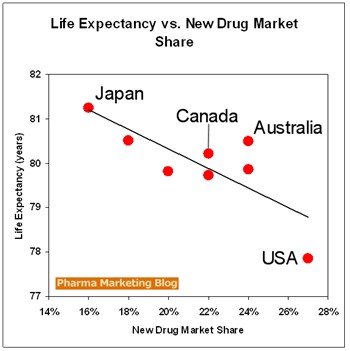
 Is there a correlation between the uptake of new drugs and life expectancy, which is a measure of the overall health of a nation?Just like Billy Tauzin, what I want most from new innovative drugs is to assure I get to live as many years as possible.So I went to the CIA data site and found the latest stats on life expectancy and plotted that against new drug uptake rates reported by ABPI. I came up with the chart on the left.Lo and behold! there does seem to be a correlation between these data. Unfortunately, it appears that it is a negative correlation: the higher the uptake of new drugs, the lower the life expectancy!
What can account for this? Billy Tauzin hinted at one possible culprit: "No doubt about it, drugs like these carry potential risk." Billy is asking us to balance benefits and risks "People understand the concept of risk and reward -- otherwise, how do you explain marriage? [whaaaa?!] But that understanding seems to break down when it comes to drugs."
Hmmm... But if the benefits are not there, then I certainly don't understand how to balance benefit and risk.
In just one day the world changed! And it changed for the better. Was it good for you too?
Of course, I'm talking about Sepracor, which I caught with its pants down on Monday (see "Lunesta, Google, and bAdWords"), changing its Google Adwords advertising Lunesta yesterday.
One day Sepracor is violating FDA regulations and running ads like this:

The next day, the Lunesta ad looks like this:

It's nice to see that the ads have been corrected. Could it be that my post woke someone up at Sepracor? Or maybe it was Sepracor's ad agency that woke up.
Fast action was required because I did notify the FDA about the ads. I don't know how FDA processes such complaints, but I suspect it takes some time for them to get around to reviewing them. So it's possible that the FDA will not come across any violative Lunesta Adwords if they are searching the Internet today.
It's not the first time that Sepracor has snuck in a questionable ad. See "Sepracor Sneaks In Lunesta Reminder Ad." What next?
CommonHealth's MBS/Vox division conducted a study of 440 physician-patient conversations, which according to industry reports -- and I'm quoting a story in the October issue of Pharmaceutical Executive (PE) Magazine -- "sought to determine how often discussions about prescription brands were taking place..." in doctors' offices.
That's not quite true. The study actually sought to show -- and does show -- that "it doesn't appear that a high percentage of patients are going to the doctor and directly [emphasis added] saying, 'I saw X brand on TV and that's what I want.' " This is a direct quote from Joseph Gattuso, president of CommonHealth's MBS/Vox division.
Can you see the difference between how PE characterizes the study's goals and what the study actually shows? Gattuso is not talking about how often discussions about brands take place in the doctor's office -- he's talking about whether or not the patient mentions seeing the brand advertised. In other words, CommonHealth is focusing only on how often DTC is mentioned in doctors' offices, not how often brands are mentioned.
Mentioning DTC ads vs. mentioning drugs by brand name; that's a big difference. But the trade press -- including PE Magazine -- is spinning the study to prove a point rather than to help understand how DTC works. The point they want to prove is that DTC does not cause consumers to ask for more expensive medicines. The study proves no such thing, yet CommonHealth is aiding and abetting the misinterpretation of its study by denying us access to their data.
Perhaps if we could see CommonHealth's data, we might be able to draw our own conclusions. Unfortunately, the data that were released by CommonHealth to me, to the trade press, and to the general public, doesn't include raw numbers, not too much about the methodology (ie, linguistic rules applied), and doesn't include any data about how often branded discussions take place (as opposed to branded discussions in which DTC advertising is mentioned).
I reported on this study back in September (see "Advertisers Don't Know How DTC Works. Say wha?"). At that time, when I asked CommonHealth analysts for more data, they demurred. That, of course, only led me to believe that they had something to hide. They did mention that a report was submitted to the FDA.
Surprisingly, the report wasn't available through the FDA or Federal Register Web sites. I had to submit a Freedom of Information Act (FOIA) request for it. I hate when I have to do an FOIA request, especially when everyone -- FDA included -- is calling for more transparency! But it's a cherished right I have as an American citizen and I made the request so you don't have to.
An FOIA request is a bureaucratic hassle and it takes some time to get results. I made my request on September 18, 2006 and got the report on November 2, 2006. Not quick, but at least a quicker turnaround than I got from PhRMA (see "PhRMA's Response - PRwise, it Stinks!"). If you want a copy, it's here (Docket2005N-0354). FREE!
[BTW, the FDA is charging me a $2.60 copying fee. That's about $0.10 per page. I figure their margin on copying FOIA documents is around 50%!]
I was expecting to find raw data, multiple tables, lots of detail about methodology, etc. You know, all that stuff that a "data-driven" agency like the FDA wants.
unfortunately, all I got was a paper copy of a cover letter and a slide deck. At first, I didn't think this exercise would be blog-worthy, but I did end up finding a couple of interesting tidbits.
First, in the CommonHealth cover letter to the FDA (see page 3 of the documents), I notice the involvement of John Kamp, Executive Director of the Coalition for Healthcare Communication, a gaggle of advertising agencies, which believes that "the patient is the decision-maker only with respect to whether a practitioner should be approached" (see "DTC without the Risk").
But the interesting bit of information -- which CommonHealth never released to the public nor to the press that I know of -- can be found on the 12th page of the slide deck printout, which I reproduce here (download the complete slide deck for a better copy):
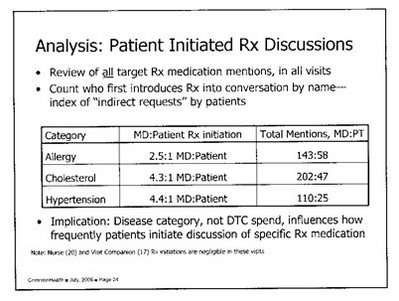 Here, we can see that there were 585 mentions of a brand name drug either by the doctor or the patient during the 440 visits recorded. True, the doctor initiated the discussion in the vast majority of cases (455 or 78% of the mentions). Yet the patient mentioned a brand name drug first in 130 cases or 22% of the mentions. That's a far greater percentage than the 1.0% to 3.9% numbers that CommonHealth focuses on in its PR campaign to make its case that DTC does not play a role in patients requesting advertised drugs.
Obviously, DTC advertising plays a huge role in raising awareness of new treatments among consumers. That role is often cited by the industry as a beneficial effect of DTC advertising. If DTC and PR, which is just another arm of DTC advertising (see "Marketing Disguised as PR"), are primarily responsible for raising awareness of drugs in the minds of consumers, then, by extension, whenever a patient mentions a drug by name in a doctor's office, that mention is due to the influence of advertising.
Despite all the obfuscation and spinning of the data, no one is really fooled. But the sad part is that there is a call out for the FDA to establish an advisory board of communication experts that will help it design better methods of communicating drug benefits and risks to consumers. This advisory board will include experts from agencies such as CommonHealth. If this study is any indication on the kinds of advice the FDA will be getting from communication experts, then I anticipate a lot of blog-worthy fodder in my future!

 I'm trying something new. It's Pharma Marketing Talk, which is a biweekly online and archived streaming audio talk radio show (podcast) that features interviews with leaders and innovators in pharmaceutical marketing. You can learn more about Pharma Marketing Talk, listen to past shows, or find out about future shows by clicking here.