Tuesday, November 07, 2006

Clear Words, Obscure Benefits

Next Tuesday at 3:05 PM, I am scheduled to give a presentation entitled "Obscure words, clear benefits" at the eyeforpharma "e-Communication and Online Marketing" conference in Philadelphia, PA.

This is the description of my presentation:
Understand business blogging, podcasting, videocasting, SMS and other new technologies
  • Keep pace with the evolution of technology: What's hot and what's not!
  • Impact vs. Risk: Learn how to evaluate the potential of interactive technologies and put them to work immediately
  • Reaching all your clients with the most effective technology. Understand why your clients love new interactive tools and find out how to use them to improve your competitive advantage
  • Will you be in the mix? Learn about the Future of Brand Marketing and discover why you cannot do without interactive media
This is very impressive, but I prefer the title "Clear Words, Obscure Benefits" to the official version ("Obscure Words, Clear Benefits"). I guess mine is the glass half-empty version.

Several weeks ago, I presented some evidence that there is a "slump" in pharmaceutical online ad spending (see "Pharma eMarketing in a Slump"). Obviously, the benefits of online marketing are not clear to pharmaceutical marketers who determine the marketing mix for their brands.

Or, it could be that they don't believe the benefits outweigh the risks. And there
are risks associated with online marketing, which I have pointed out here in this blog as well as in Pharma Marketing News (see, for example, "The Brand Marketing Mix").

What I will cover in my presentation is a methodology for analyzing the risks versus the benefits of online marketing. There is no one answer for every pharmaceutical company nor for every product.

But, I don't want to give the whole thing away!

Live Podcast from the Conference!
I hope you plan to be at the conference and attend my presentation. If not, give me a call during my half-hour
live podcast from the conference at 1:00 PM on Tuesday, November 14, 2006. This is a segment of my bi-weekly show entitled "Pharma Marketing Talk," which is a "talk radio" style show that you can listen to live or download to your iPod.

I plan to interview attendees on their opinions on trends in using technology for pharmaceutical marketing. I will also take calls from online listeners during the show.

This may be the very first time anything like this has been attempted at an pharmaceutical industry trade show. For more information, including instructions for listening live and calling in during the show, see www.pharma-mkting.com/talk/pmtalk.htm.

Sunday, November 05, 2006

Lunesta, Google, and "bAdWords"

Last week I wrote about the online Sleep drug ad wars (see "AmbienCR and Lunesta Duke It Out on Web").

Today I focus on the ads themselves, and especially the "Adwords" sponsored by Lunesta and Rozerem and served up by Google. Specifically, I focus on how Lunesta is in violation of FDA regulations regarding DTC advertising and how Google Adwords allow this to happen.

Here's an example of such an ad:


This is a screen capture I made on November 2, 2006. As I also pointed out last week, you can do a Google search on "sleep medication" and find these ads at the top of the screen in the "Sponsored Links" area.

There's no doubt that the drug companies pay for these ads.

Lunesta Adword is "bAdword"
Can you see how the Lunesta ad is "violative," which is FDA jargon for breaking the law?

I won't keep you in suspense any longer. Notice that the ad mentions both the brand name (Lunesta) and the indication or rather the benefit, which is sleep (as in "Lunesta Sleep Drug"). It also manages to tell you that you can get a full night's sleep with Lunesta.

What the ad doesn't tell you -- and what the FDA requires all drug ads that mention the brand name and the indication or benefits to tell you -- is the major side effects. Or at least provide a direct link to a brief summary of the product labeling as in the Rozerem ad shown on the left. In this ad all you need to do to get the required information is to roll your mouse over the appropriately labeled area. Even so, this ad may also have been violative if it mentioned the indication because mouse rollovers may not be considered "fair balance" by the FDA. The Rozerem ad shown on the left and the Rozerem Adword shown above do not mention sleep, so they are fine as far as the FDA is concerned.

The Rozerem Adword is what's called a "reminder ad." Recent voluntary PhRMA DTC advertising guidelines call for an end to reminder ads on TV, but not in print or on the Internet.

The Lunesta "bAdword" on the other hand is not a reminder ad and the Sepracor folks should receive an FDA cease and desist letter (ie, "warning letter").

Under normal circumstances, that is not likely to happen because (1) the FDA is too busy or too short on manpower to notice and I doubt that they do a systematic review of the Internet to make sure DTC ads served on it are on the up and up; and (2) Adwords served by Google are fleeting; you can see them one minute and then lose them if you reload the page. The FDA can't say, go to www.pharmamarketingblog.com and you will see the violative Adword. It just may not show up!

Does this AdWord Violate FDA's DTC Rules?
Yes No Not Sure

Complaint Filed With FDA
Realizing that the FDA would never catch this, I reported the violative Lunesta Adword to the appropriate person at DDMAC, the division that oversees DTC advertising. On November 1, 2006 I sent this person an email with attached screen shots as evidence. She sent back an email return receipt and called me to confirm that the FDA would register my complaint and look into this violation.

My conversation with the FDA confirms that these kinds of violations on the Internet are a problem for regulators. It's difficult to keep up with the technology, for one thing. How many ways can ads be served up on the Internet that are virtually impossible to track?

The FDA also does not have any specific guidance for DTC advertising on the Internet and has always said that the same rules apply to the Internet as apply to print and TV.

Personally, I think it's about time for the FDA to stop sweeping Internet drug advertising issues under the rug and come up with some Internet-specific regulations or guidance. For example, is it OK to leave out fair balance in Google Adwords? I don't think so, but Sepracor, who markets Lunesta, can claim that it is hardly possible to include all that information in an Adword, which limits you to 70 characters. I don't buy this as an excuse, by the way. If you can't provide fair balance, then stick to reminder ads or nonbranded advertising like Rozerem does.

This is also about providing a level playing field. If you are a Rozerem ad team person -- and I know a lot of you read this blog -- I suggest that you complain about the Lunesta "bAdwords" program to the FDA. After all, you are playing by the rules, why shouldn't Lunesta?

Industry Self-Regulation Also Needed
Regulations and guidance from the FDA is always the court of last resort as far as the pharmaceutical industry is concerned. Therefore, I suggest that PhRMA get off its butt and issue guidelines for DTC advertising on the Internet as it suggested it would do back when it came out with its TV and print DTC guidelines.

That's my opinion and I'm sticking to it!


Word to Google: If you want to serve pharmaceutical sponsored ads, maybe you can help keep the playing field level and be sure to review each ad that mentions a brand name drug to ensure that it's not violative of FDA regulations. Why not have a "DTC Ad Checker?" You already have some guidelines about serving DTC ads only to US Web sites. That means you attempt to obey EU and other non-US laws. Why not ensure that US law is also upheld? Maybe FDA should give you guys a call about that.

I know you are smart enough to do this. So no excuses, OK?

Thursday, November 02, 2006

Marketer vs. Marketeer: Synonymous?

I've attended many pharmaceutical marketing conferences and heard some speakers refer to themselves are 'marketers' and some as 'marketeers.'

I prefer "marketer." For one thing, I've never been to a pharmaceutical "marketeering" conference. But mostly, I think "marketeer", which is pronounced like "Mouseketeer," reminds me of the Mickey Mouse Club that was popular in the fifties! You might have been a member as a kid.


In other words, marketeer is a bit disparaging in a Mickey Mouse sort of way! Whenever someone calls himself a "marketeer," I'm seeing that kid in the video above.

The reason why I am talking about this is because I recently came across an instance where the term "marketeer" was used as a put down rather than as an endearing term used by marketers. It was in a Newsday article about the AMA calling for a 6-month to 1-year moratorium on DTC advertising for new drugs (see "AMA asks for restrictions on drug ads)":
"I don't think direct-to-consumer advertising is appropriate," said Brian R. Malone, director of pharmacy at Winthrop-University Hospital in Mineola, NY. "It's marketeering [my emphasis], and it may cost the consumers more because they may have been able to buy a less expensive generic drug."

[BTW, it is NOT news that the AMA wants a moratorium on DTC! I wrote about this back in June. See "AMA vs DTC: Spinmeisters at Work".]
Don't you think that's a put down?

I mean, if Mr. Malone had said "It's marketing...", my response would have been "Duh!" and I would have moved on.

Now that I think of it, there's another put down here: by saying "marketeering" in the same sentence with "cost the consumer more", the term conjures up "profiteering." Silly me! That's what this guy is getting at!

Of course, looking more closely, I find that the whole article is a put down. For example, a doctor is quoted in the article thusly:
"Langston said many doctors, himself included, have patients walk in and say, 'Doctor, I saw this on TV; this is what I need.'"
Thanks to new research from Commonhealth, we all know this is an old wives tale. According to that research, patients rarely ask for drugs that they've seen advertised (see "Advertisers Don't Know How DTC Works. Say wha?"). Of course, if this research is accurate, I wonder why every DTC ad urges us to "Ask Your Doctor if Brand X is Right for You." Could it be that the Commonhealth study was faulty?
[Us mere mortals have only Commonhealth's interpretation of the data, not the data itself. Commonhealth, however, submitted their study to the FDA. Hopefully, it included the raw data and detials of the methodology used. Whatever was submitted, you can only get a hold of it through a FOIA request, which I dutifully made a while ago. As soon as I get a response from the FDA, I'll show you the data (if there is any).]
Anyway, I think that pharmaceutical "marketers" who refer to themselves as "marketeers" should stop it! You're just playing into the hands of the Malones of this world. That's my opinion and I'm sticking to it!

Wednesday, November 01, 2006

Rozerem Sleeper Cell at Pri-Med Conference

At the DTC in the New Era conference last week, I heard an interesting statement from Dale Taylor, President & CEO of AbelsonTaylor, Inc., an agency responsible for the Rozerem promotional campaign. He said that the professional Rozerem campaign promotes a "completely different message" than the DTC campaign and you won't find any beavers or Lincoln images in the physician promo pieces -- although the patient pamphlets DO feature Abe and the Beav.

Since hearing that, I am dying to actually see what Takeda is telling doctors. After all, "only your doctor can tell you how Rozerem is different" according to the DTC ads.

Then I spotted the post "Grabbing MDs attention at conference exhibitions" over at PharmaGossip and followed the link to Dr. Kevin Pho's Medical Weblog where he published several amusing photos of pharmaceutical medical meeting exhibit tricks he uncovered at the recent Pri-Med East 2006 conference (see "How to get a doctor's attention; or, how far will drug reps go?").

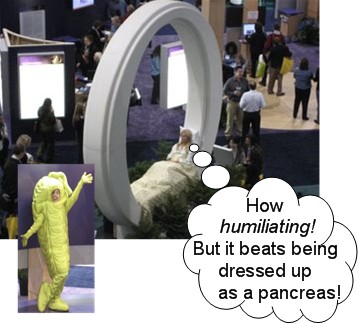
Lo and Behold! Dr. Pho took a Rozerem exhibit photo, a retouched version of which I present here:

"Sleeping all day in your pajamas! (The "O" is for Rozerem - and yes, that was a real person sleeping there. Nice work if you can get it.)" -- says Dr. Pho.
I don't suppose hiring a model to sleep all day is as expensive as hiring one to imitate a pancreas. So at least Takeda saved some money there, although I got to wonder how they ship that "O" around!

The "O" in this physician promotional campaign is as mysterious as "Abe and the Beav" in the DTC campaign. What does it mean? I know there's no "O" in Lunesta or Ambien. Can that be it?

I suspect that the overriding goal of this exhibit is the same as the goal for the DTC campaign, which was so eloquently stated by Mr. Taylor: "to be different" and to create "buzz" (see "
Rozerem Ads Innovatively Ineffectual"). I don't see very many physicians, however, "buzzing" around the "O" exhibit here.

Dr. Pho couldn't tell me what the Takeda reps in the Rozerem booth were telling docs about Rozerem: "I'll be honest," he said, "I had no interest in Rozerem and didn't go into the booth."

[BTW, I am not the only person who thinks "cutting through the clutter" should NOT be the overriding principle behind advertising. See "
'We wanted an ad that people talked about' That is pure BS! over at the DTC Marketing Blog.]

If you look at the Pri-Med East 2006 exhibitor list and click on Takeda Pharmaceuticals (
here), you will get a tidbit of the message aimed at physicians:
"Come and learn more about Rozerem™ (ramerlteon), the first and only nonscheduled prescription insomnia product that targets the normal sleep-wake cycle, does not act by CNS depression and is approved for long-term use."
Succinct! And it manages to get across 3 or 4 key differentiators. Yet the only one covered in the DTC ads is "approved for long-term care."

FDA Regulation of Medical Exhibits and Conference Web Sites
BTW, how are little promos like this on medical conference sites sponsored by CME providers like M|C Communications -- host of the Pri-Med Conference --
regulated by the FDA? For example, the benefit statement above is not balanced by risk information, nor is there any link on this page to the package insert or to the Rozerem Web site where the physician can see the PI.

Perhaps M|C Communications will claim that they wrote the promo, not Takeda and the FDA has no jurisdiction over what it can say. Yeah, right!

Monday, October 30, 2006

AmbienCR and Lunesta Duke It Out on Web

AmbienCR and Lunesta are battling for the leader position in the sleep aid market and are currently "duking it out" on the Internet via search engine ad campaigns.

I've shown the following chart before (see "Rozerem Ads Innovatively Ineffectual") that implies that these two products are the major contenders in this market while Rozerem is a distant third.

You may have seen AmbienCR banners served by Google Adwords appearing on various Web sites. The following are a couple of examples:


and..


These are "nonbranded" text ads that at first glance appear to be bogus ads put up by sleazy companies to get you to their Web sites where there are dozens of other ads. These sorts of sites make money by serving Google Adword ads.

Do a Google search on "Sleep Medication." What do you find? This:

Sleep Medication
SleepMedication.Info Find
Medication to Get You to Sleep Fast & Stay Asleep - Free Trial

Sleep Medication
www.lunesta.com Try our sleep aid free for 7 nights with the Lunesta 7-Night Challenge.

That's at the top of the page in the "Sponsored Links" area. The first listing in the natural results section is this:

Shuteye.com: Consider Medications
When you first start taking any
sleep medication, use extreme care while doing anything that requires complete alertness, such as driving a car or operating ...

Sleepmedication.info is merely an AmbienCR free trial offer page. Too bad Sanofi-Aventis couldn't get SleepMedication.com. That's one of the "sleazy" sites I was talking about. I guess ".info" is a notch less sleazy.

The AmbienCR folks are being very aggressive in collecting personal information from you when you apply for the 7-day free trial (why 7 days?). You have to opt-out rather than opt-in to receive further communications from "sanofi-aventis U.S. LLC, its affiliates, and the business service companies working with the company". By not unchecking this box, you give S-A permission to use the data to:
  • Provide information about insomnia, related conditions and products; and
  • Develop products and services concerning insomnia which may include market research.
If you are not careful and forget to uncheck another box, you will also receive an Email "Newsletter," which we all know is more advertising.

Of course, I left every box checked just to see what would happen. I did get a printable coupon, but forgot to print it. I haven't received any email newsletter. Oh, well! At least there is a way to "unsubscribe" online and by phone. I'll let you know how that works later.
Related Posts Plugin for WordPress, Blogger...